
What are Canadian values?
In recent months we’ve heard a lot of talk about Canadian values. But who gets to pick or define what Canadian values are? And what are Reformed Christians to do if we oppose something that is touted as a Canadian value?
For example, it seems like an acceptance of the LGBTQ cause is a Canadian value, or at least the manifestation of the Canadian value of diversity. In releasing his government’s 2SLGBTQI+ Action Plan, former prime minister Justin Trudeau said, “Canada gets a little bit stronger every day that we choose to embrace and to celebrate who we are, in all our uniqueness. We are a diverse nation enriched by the lives, experiences, and contributions of 2SLGBTQI+ people. Let us celebrate all the communities that make Canada such a diverse country, and work together to build a better future we can all be proud of.”
So has acceptance of progressive sexual and gender ethics become a full-fledged Canadian value? Or are there pockets of citizens who still cling to God’s intention for sexuality and marriage?
A recent report sheds light on these questions. For the third time in five years, the polling company Ipsos released an LGBTQ+ Pride Report. The report surveyed 17,525 people in 23 countries around the world, including Canada, asking them about their personal and political attitudes towards various issues. While many surveys or news reports combine sexual orientation and gender identity to the broad LGBT movement, this report generally distinguishes between sexual orientation (i.e. the LGB) from the gender identity (i.e. the T).
Although there is much cause for disappointment in these numbers, there are also glimmers of hope.
Attitudes in 2025
Overall, Canada ranks right in the middle of the countries surveyed, being the 11th most supportive of progressive sexual and gender ethics. But there are limits to how far Canadians are willing to take these revolutionary ethics and how strongly they hold to each of them. From this survey data on these seventeen questions, there are four buckets of responses among Canadians.
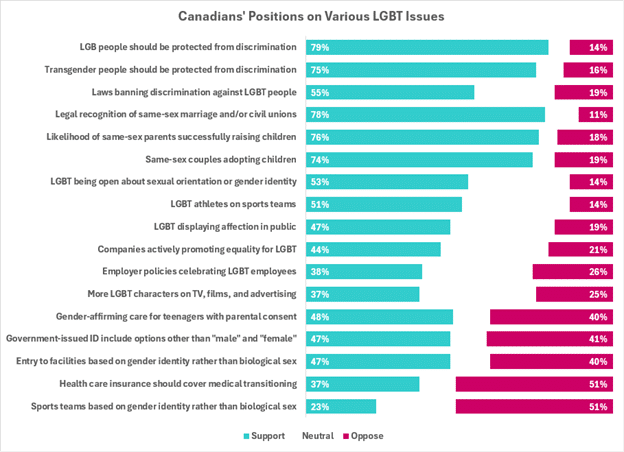
First of all, there are consensus opinions in favour of anti-discrimination policies and same-sex families. Over 75% of Canadians support protecting LGBT people from discrimination in general, though only 55% percent think that these protections should be entrenched in law. (Perhaps the 20% difference is from those who think that people should not discriminated against in their personal lives but don’t want the government stepping in.) Over 70% also support same-sex marriage and same-sex couples raising children, with less than 20% opposed.
Second, there is the lukewarm support for the promotion of the LGBT cause in culture, sport, and business. Around 35% of Canadians are neutral on questions such as whether people who identify as LGBT should be open about their identity, join sports teams, display affection in public, or receive more attention in television and advertising. A similar number are apathetic towards company policies or celebrations of LGBT employees. Despite the significant percentage of Canadians who don’t have strong opinions on these matters, a plurality of Canadians still supports such actions.
Third, there are the polarizing issues. On questions dealing with the permissibility of medical transitioning for minors, government-issued ID offering options other than “male” or “female,” and entry to facilities based on gender identity rather than biological sex, there is only a 6-8% gap between support for and opposition against these policies. Few Canadians take neutral positions on these topics.
Finally, there is strong opposition (at 51%) against private or public health insurance covering medical transitioning and admission to sports teams based on gender identity rather than biological sex.
Change in attitudes since 2021
Not only does the report measure Canadians’ attitudes today, but it also measures how those attitudes have changed in the past four years. And while there might not be many encouraging numbers on the state of Canadian public opinion today, we can draw much more encouragement from recent changes in public opinion.
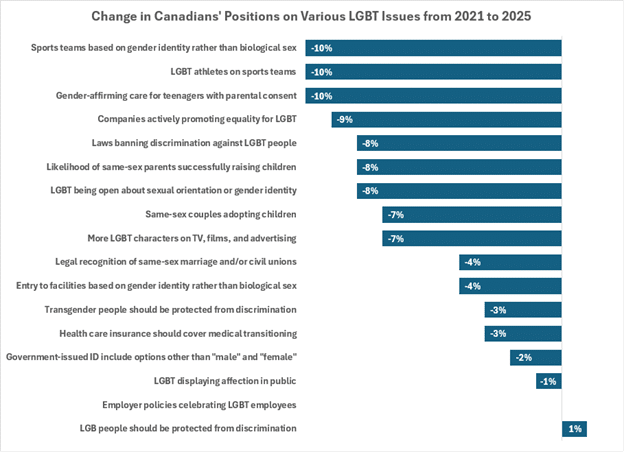
Across seventeen questions, support for the LGBT cause declined over 15 of the questions (with no change on one question and a slight increase on another). On nine questions, support declined by at least seven percent. Support for LGBT athletes on sports teams, participation on sports teams being based on gender identity rather than biological sex, and “gender-affirming care” for teenagers declined the most at 10% each. So, after a radical pendulum swing in favour of the LGBT cause, we may be finally seeing a swing back in the other direction.
A road map for action
Although public opinion is subject to change and individual public opinion polls always have a margin for error, these survey results suggest a road map for action. Given the strong consensus among Canadians in favour of anti-discrimination or same-sex family policies, it would be very difficult to change these policies in the near term. As much as Reformed Christians might want our country to revert back to a traditional form of marriage and family or oppose the entrenchment of the concepts of sexual orientation or gender identity in human rights codes, those changes are going to be tall orders. Same-sex marriage has been legal in Canada for twenty years. The additions of sexual orientation and gender identity into provincial and federal human rights codes are about a decade old. But despite their novelty, these seem like the last policies that will be overturned. And it would be wise – or at least efficient – to spend comparatively little time calling for political change on these issues and instead focus on changing individual hearts and minds.
However, these survey results suggest that there are many “trans issues” where we have a real shot of making change.
Regarding sport, two questions seem to give conflicting reports. How can 29% more Canadians be supportive of than opposed to of LGBT athletes playing on sports teams and yet 28% more Canadians be more opposed to than supportive of entry to sports teams being based on gender identity rather than biological sex? Well, the likely answer is that many Canadians don’t care if they have a same-sex attracted teammate or if there is a person who identifies as transgender playing in a co-ed league. In other words, they don’t have concerns about people who identify as LGBT participating in sport. However, Canadians are staunchly opposed to men claiming to be women playing on women’s only sports teams. British Columbia and Alberta have recently tried to capitalize on this. And support for LGBT participation in sport on both questions on this survey declined by 10% in the past four years.
Pushing back against medical transitioning is also a winnable issue. Despite the pro-medical transitioning side claiming that “gender-affirming care” is life-saving and virtually every provincial government funding medical gender transitions, most Canadians do not want public funds to pay for these destructive procedures. And while it seems like there is a split decision in this data on the question of medical transitioning for minors (48% in favour versus 40% opposed), adding more nuance to the question helps to illustrate the opposition to the practice. For example, a 2024 Leger poll found that support for allowing medical transition for minors without parental consent was only 11%, support for allowing medical transition with parental consent was 30%, and entirely banning medical transition for minors was 42%. A clear plurality of Canadians want these procedures banned. That’s why we started the Let Kids Be campaign.
Although there might be other factors at play on these two issues (e.g. fairness in sport or health concerns over medical transitioning), it is likely that Canadians are uneasy to acknowledge that a man can in fact be a woman or a girl can be a boy. This can be seen in the polarized positions on gender on government-issued ID and entry to facilities based on gender identity rather than biological sex. Even if Canadians have broadly accepted tolerance of homosexuality as a Canadian value, there is still quite a bit of skepticism about transgenderism.
Glimmers of Hope
Although Canadian values are largely offside God’s created order of gender and sexuality, there are glimmers of hope. Not that our hope is in earthly change, for “we rejoice in hope of the glory of God. Not only that, but we rejoice in our sufferings, knowing that suffering produces endurance, and endurance produces character, and character produces hope, and hope does not put us to shame, because God’s love has been poured into our hearts through the Holy Spirit who has been given to us” (Romans 5:2-5). But the Canadian public hasn’t entirely bought transgender ideology yet, especially when it comes to the issues of medical transitioning and sports policy. And we are seeing a trend in the right direction, with declining support across the board for the LGBTQ cause.
So there is hope for change in the near future and Canadian values may be moving into greater alignment with God’s creational order.