How Far Our First Freedom Has Fallen


Available in Audio Format:
Do you know what the very first right or freedom guaranteed in the Charter of Rights and Freedoms is?
It’s not freedom of speech.
It’s not the right to vote.
It’s not even the right to life.
It’s freedom of conscience and religion. This highlights how important these freedoms are in a free and democratic society.
This first freedom aligns with the biblical revelation that God gives every human being a conscience, an innate notion of right and wrong. Paul writes that all people “know God’s righteous decree” (Romans 1:32). Unbelievers, “who do not have the law, by nature do what the law requires, they are a law to themselves, even though they do not have the law. They show that the work of the law is written on their hearts, while their conscience also bears witness” (Romans 2:14-15).
We’ve seen people articulating their conscientious beliefs throughout history. Shadrach, Meshach, and Abed-Nego followed their conscience and appealed to an authority higher than the king: “We have no need to answer you in this matter … our God whom we serve is able to deliver us from the burning fiery furnace … But if not, let it be known to you, O king, that we do not serve your gods, nor will we worship the gold image which you have set up” (Daniel 3:16-18).
Several centuries later, Roman emperors demanded to be hailed as gods. In response, the early church father Tertullian stated, “Never will I call the emperor God, and that either because it is not in me to be guilty of falsehood; or that I dare not turn him into ridicule; or that not even himself will desire to have that high name applied to him.” Because of his conscience, Tertullian could not state as true something he believed to be false.
In the Middle Ages, Martin Luther stood before the Diet of Worms to defend his theses against the Roman Catholic Church. He defended himself by saying, “My conscience is captive to the Word of God. Thus I cannot and will not recant, because acting against one’s conscience is neither safe nor sound. Here I stand; I can do no other. God help me.”
During the World Wars, conscientious objectors refused to bear arms or participate in military service due to their moral objection to the use of lethal force. The issue intensified when the federal government conscripted soldiers to fight in both wars. The movie Hacksaw Ridge movingly recounts the story of one such conscientious objector.
As we can see from these examples, freedom of conscience as a constitutional right is supposed to limit the power of the government by protecting people from being coerced into doing something that they think is wrong. It both protects the personal integrity of individuals and limits the state at the same time.
Today, conscience rights are most commonly invoked in the medical field. Preserving conscience rights in health care is the subject of one of ARPA’s policy reports. One of our recommendations is that, “[R]ecognizing that Canadians disagree on the morality and/or medical necessity or advisability of abortion, the use of opposite-sex hormones, or body modification surgeries, the federal government should make it a criminal offence to coerce any healthcare professionals to provide or participate in elective procedures for non-life-threatening conditions or illnesses.”
But how popular is this suggestion?
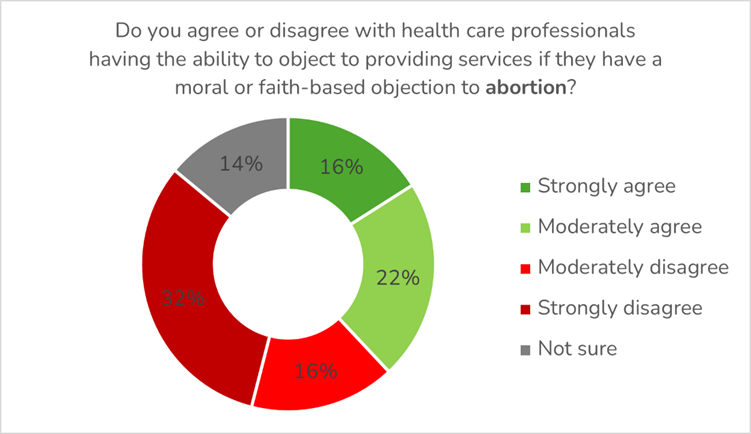
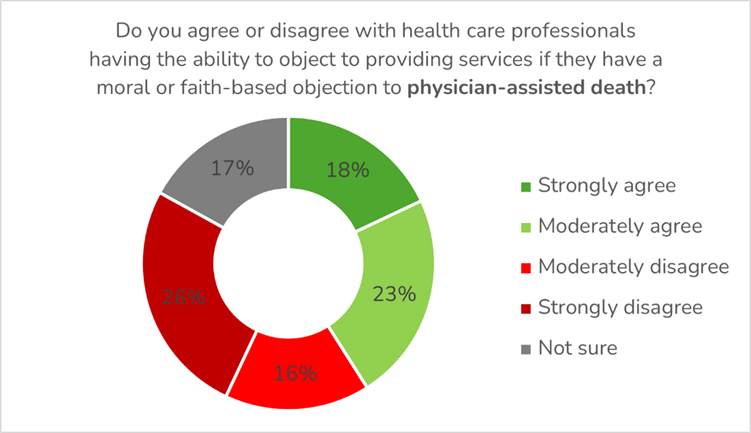
Early in April, Research Co released a poll on Canadians’ views on freedom of conscience in health care. Unfortunately, this latest poll reveals that Canadians aren’t all that enamoured with conscience rights. Respondents were asked whether they agree or disagree with health care professionals having the ability to object to providing services in three situations. On euthanasia, support and opposition were effectively tied at 41% to 42%. On abortion, opposition to conscience rights exceeded support 48% to 38%.
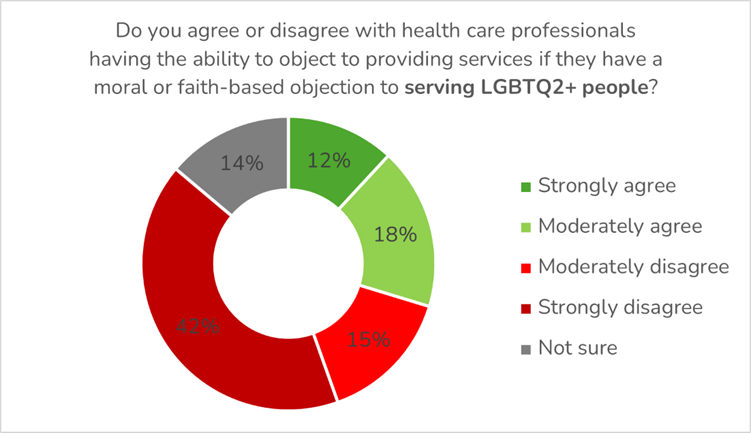
The final question asked about moral or faith-based objections to “serving LGBTQ2+ people.” But this is very poor wording. No health care professional would refuse to serve persons who identify as LGBTQ2+ because they identify that way. And if a medical professional did so, they would be in legal trouble very fast, and risk losing their license.
Nor should a Christian medical professional do so. Every person is made in the image of God and deserving of equal treatment in every circumstance where personal characteristics are irrelevant.
With the question so worded, many faithful Christians might strongly oppose faith-based objections. All health care professionals should help people with real medical needs, regardless of personal characteristics and identities, whether that be a woman who identifies as transgender in need of a hip surgery, a man who identifies as gay pursuing cancer treatment, a Muslim patient needing stitches, or a black woman giving birth.
It is different, however, when the service sought is itself morally objectionable. For example, providing a sex-denying surgery for a patient who identifies as transgender or prescribing puberty blockers for a child with gender dysphoria. Both interventions are medically unnecessary, harmful, and affirm an anthropology that Christians know is wrong and destructive.
With the badly worded question, which implies bigoted objections to serving people who identify as LGBTQ2+ in any capacity whatsoever, opposition to conscience rights rises to 57% and support falls to 30%. And of those 30%, most likely saw through the badly worded question and tried to answer as if it were more appropriately worded. Still, if Research Co had asked a better-worded question (e.g. on a moral or faith-based objection to sex reassignment surgeries), they would likely have had different results.
The final question asked whether people would support or oppose a law “to allow health care professionals the ability to have a moral or faith-based objection to providing services.” In other words, are conscience rights important enough that the government should step in to protect them? On this question, just 38% of Canadians support such conscience rights and 46% oppose. And the intensity of the opposition is much stronger than the intensity of the support. Two and a half times as many respondents strongly oppose (30%) as strongly support (12%) such a measure.
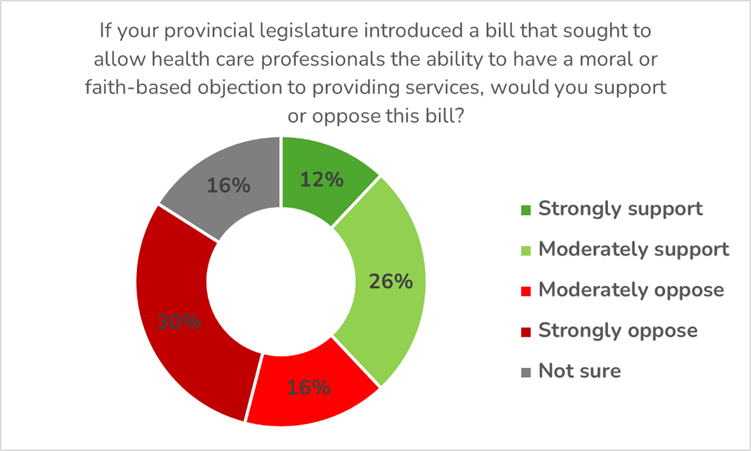
This is how far our first freedom has fallen.
There are at least three possible reasons for this skepticism around conscience rights. One is simply that Canadians are growing more selfish and feel entitled to a health care procedure of their choosing regardless of their doctor’s beliefs. There is already a strong culture of medical entitlement in Canada. Our publicly funded health system consistently ranks as a point of Canadian pride (despite how poorly the system functions at the moment). The Supreme Court rulings in Carter and Morgentaler have often been interpreted to mean that Canadians have a “right” to euthanasia or abortion. So perhaps it shouldn’t be surprising that Canadians want to force doctors to facilitate procedures against their will. So much for Canadian politeness.
But the flip side is that Canadians simply don’t care about or even understand the importance of conscience or how it is formed. Religion, as exemplified in most of the examples mentioned in the beginning of this piece, often informs and strengthens conscientious beliefs. Religion supports conscientious beliefs by not only surrounding an individual with like-minded individuals, but also asserting that there is an authority higher than the state that people are called to submit to. Thus, as religiosity has declined in Canada, so too has conscience.
Or perhaps this is the teaching function of the law at work. As Canadian law permits abortion, euthanasia, same-sex marriage, and gender transitioning, many Canadians consider these activities as not only permissible, but morally good. Perhaps Canadians are looking to the state rather than their own conscience to know what is right or wrong or, more precisely, that the state is shaping the conscience of its citizens. Such Canadians will increasingly look with incomprehension at those who still follow a different moral viewpoint informed by something other than the state.
Without robust conscience rights to protect them, Christians will find it harder to practice in many areas of medicine. Family doctors are increasingly asked to prescribe the abortion pill and gender transitioning hormones. Surgeons, anesthetists, and operating room nurses will be asked to participate in sex-denying surgeries. Physicians and nurse practitioners in hospices or long-term care units will increasingly be asked to provide euthanasia.
It is a sad day indeed when Christians – who founded the first hospitals centuries ago – find it hard to work in these same health care institutions in the twenty-first century.