
Canadians should be free from harassment, intimidation, or obstruction when attending a place of worship. Yet, increasingly, religious adherents are being intimidated and places of worship are attacked. In response, governments have enacted so-called “access zones” or “bubble zones,” which restrict certain activities within a set distance of a place of worship.
But could such laws unduly limit freedom of expression?
Before considering the merits of religious bubble zones themselves, we should first look at other laws that protect religious communities and religious worship – laws that long precede bubble zone laws. Second, we should compare these new religious bubble zone laws with other kinds of bubble zone laws.
Criminal Code protections
The Criminal Code prohibits various intrusions on places of worship and crimes against religious adherents, covering a wide range of criminal activities.
Currently, it is an offence (namely, mischief – Criminal Code, section 430) to obstruct, interfere with, or interrupt “any person in the lawful use, enjoyment or operation of property,” or to destroy or damage said property. The Criminal Code also clarifies that this offence applies to obstructing access to a building used for religious worship or by an identifiable group.
The Criminal Code also prohibits (section 423) intimidation by using violence or threats, persistently following a person, watching the place where a person lives or works, and blocking or obstructing a highway.
The Criminal Code alsoprohibits (section 176) obstructing or trying to obstruct a clergyman from celebrating a religious service or carrying out an assault or violence against a clergyman. The same section prohibits disturbing or interrupting a worship service or other group meeting.
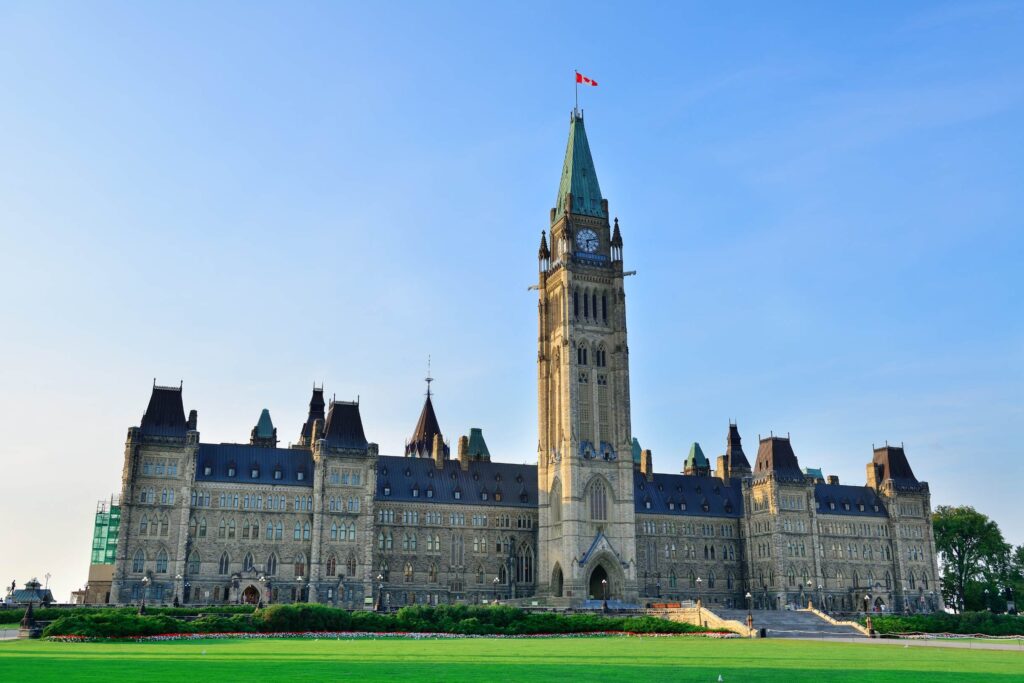
Federal Bill C-9
Yet some government officials think more is needed to protect places of worship. The federal government’s Bill C-9, if passed, would remove the mischief offence as it relates to religious property and other cultural institutions. In its place, Bill C-9 would prohibit any conduct intended to provoke a state of fear in order to impede access to a building used for religious worship. Similarly, it would prohibit intentional obstruction or interference with lawful access to any of these places. Such activity would be punishable by up to ten years in prison or longer if the offence is motivated by hatred. (A similar prohibition was enacted in 2021in relation to access to health care facilities.)
While this legislation doesn’t officially establish bubble zones around houses of worship, it does take some cues from bubble zone legislation at the provincial and municipal levels.
Bubble Zones
The idea behind bubble zones or access zones is to prevent activities within a particular area so that access to a certain facility is not hindered. Proponents would say it’s not about limiting speech per se but providing safety and access for those using specific facilities.
Bubble zones were first introduced in response to abortion-related protests, some of which involved physically obstructing access to an abortion clinic in the 1990s. British Columbia passed Canada’s first bubble zone law in 1995. It was the only one of its kind in Canada until 2016. But today, Newfoundland, Quebec, Ontario, Alberta, Nova Scotia, and Manitoba also have these bubble zones around abortion clinics.
Provinces passed similar laws in relation to hospitals following protests over COVID-19, and in relation to schools to prevent protests against SOGI education.
The newest type of bubble zones are municipal bylaws to protect places of worship, hospitals, child-care centres, and schools. Vaughan, Brampton, and Toronto recently passed bylaws forbidding “nuisance demonstrations” within 100 metres of such facilities. Under these bylaws, protesting is forbidden if it is likely to cause a reasonable person to be intimidated or unable to access a particular location or service.
More recently, provincial governments are also beginning to consider religious bubble zones.
BC’s Bill 13
The BC government says that its Bill 13 will protect access to places of worship by prohibiting conduct that “impedes access, disrupts activities… or causes concern for a person’s physical or mental safety.”
The bill allows places of worship to establish an access zone (by posting specific signage) within which impeding access, disrupting activities, or intimidating attendees is prohibited. That access zone would cover the place of worship and extend 20 metres beyond its boundaries.
Ontario’s Bill 16
Similarly, Bill 16 in Ontario, would forbid certain activities within an access zone for a religious institution. In that access zone, people would be prohibited from trying to dissuade someone from accessing a religious institution.
The access zone would apply to the property of the religious institution and to an area within 150 metres of its boundary.
While this is a private members’ bill introduced by an MPP who is not in government, the Ford government also indicated early in March that it will introduce legislation to restrict disruptive protests around places of worship. Details of that legislation have not been released.
Religious Access Zones
So, what should Reformed Christians think about laws that prohibit certain activities near places of worship? At first glance, they may sound great. No one should be hindered from attending a worship service, and no one should fear to visit a place of worship in Canada.
While people should be free to criticize or question another religion or the actions of religious adherents, no one may stop others from practicing their religion via intimidation, assault, threats, harassment, mischief, vandalism, or terrorism – all of which are crimes in Canada. The Criminal Code includes general prohibitions, but also special prohibitions to protect places of worship.
Potential Benefits of Religious Access Zones
Religious access zones may provide police with a simpler tool than the criminal law for preventing obstructive and disruptive conduct. It is easier to charge and convict someone under provincial law than under criminal law. The latter requires proving that the accused person subjectively intended to obstruct or intimidate – beyond a reasonable doubt.
As a result, they may be able to address protests which have not reached a criminal bar but threaten to do so. Because of violence against Jewish communities, for example, Jews may be less willing to attend their synagogue due to a planned protest even if that protest does not escalate to physical intimidation.
Challenges with Religious Access Zones
In one sense, religious bubble zone laws are unnecessary. They target intimidating and threatening conduct that prevents people from accessing a place of worship – conduct which is already illegal. Many of the problems happening around places of worship can and should be dealt with by enforcing the criminal law.
But the main problem with the proposed provincial religious bubble zone laws is not that the standard for conviction is lower. Neither is the problem what these zones seek to protect against. It is that some of these bubble zone laws would capture conduct that is not obstructive or intimidating. For example, both Bill 16 in Ontario and Bill 13 in BC would prohibit (within the bubble zone) attempting to persuade someone, by any means, not to attend a place of worship.
The criminal law restricts speech in a way that prevents physical violence, intimidation, and threats. Religious bubble zones extend beyond such conduct to restrict peaceful speech that would be legal if practiced in other locations.
The original ‘bubble zones’: abortion clinics
Bubble zones can be tools for censorship. Take abortion bubble zones, for example. These bubble zones go beyond prohibiting harassment or intimidation (which the criminal law already prohibits). Rather, they prohibit Canadians from merely (a) attempting to dissuade someone from having an abortion, (b) sharing information about abortion or pregnancy care, and (c) expressing disapproval of abortion. Abortion bubble zones are also one-sided. They don’t prohibit people from talking about abortion. Rather, they forbid expressing disapproval of abortion.
Abortion bubble zones go beyond proposed religious bubble zones by prohibiting sharing information and expressing disapproval. Religious bubble zones do not target criticism of religion in the same way.
Conclusion
Certainly, some bubble zone laws are worse than others. But both abortion bubble zones and religious bubble zones stem from a desire to ensure unencumbered access to something the government deems important. Both include elements already prohibited by the Criminal Code and extend beyond that. Governments should enforce laws that protect all people from intimidation, obstruction, and worse, wherever they are. Laws that censor peaceful speech in specific public “zones” are, at times, unnecessary, and may instead be problematic.