
Articles in the Canadian Medical Association Journal and the Canadian Journal of Public Health in recent years have shed light on the reality of late-term abortion from an unexpected angle: many late-term abortions are classified as stillbirths.
Canadian provinces define a stillbirth as the birth of a fetus at or after 20 weeks’ gestation or with a birth weight of over 500 g that shows no sign of life. Both cutoffs roughly reflect when a pre-born child is likely to be able to survive outside of the womb.
Because this definition requires the pre-born child to be born to be legally declared dead, such a definition counts the deaths of pre-born children in many different circumstances as stillbirths: a full-term child who dies during a complicated delivery, a miscarriage at 24 weeks, or even a twin who died at 8 weeks but who was born with the healthy full-term twin months later.
But it also includes late-term abortions. According to the article, there is “widespread uptake of prenatal diagnosis and induced abortion for congenital anomalies in Canada.” For example, if a couple finds out in the second half of their pregnancy that their pre-born child has Down syndrome, a heart defect, or a cleft palate, they will often choose to abort that pre-born child. Using either surgical or medical means, the pre-born child is killed in utero and then born. The article even mentions “the increase in stillbirths with missing birth weight from 1.7 in 2000 to 4.5 per 1000 total births in 2010. This likely reflects an increase in late induced abortions (at 20–24 weeks’ gestation) using a dilation and evacuation procedure, which precludes separate weighing of the fetus and placenta and results in a missing birth weight.”
This “dilation and evacuation procedure” is a sanitized way of saying that the pre-born child is ripped out of the womb piece by piece.
Furthermore, it also includes “fetal reductions” in “multi-fetal pregnancies.” In other words, killing one (or more) pre-born child(ren) in a pregnancy containing twins, triplets, etc. The article’s authors claim that the reason for aborting these children is to increase the likelihood that the other pre-born child(ren) will be born alive and healthy, though some parents may abort simply because they don’t want more than one child. Either way, the pre-born children killed by these “fetal reductions” are only born when their healthy sibling is born and thus are deemed to be stillborn according to Canadian statistics.
Because the definition of “stillborn” doesn’t differentiate whether the baby died naturally or was murdered, such late-term abortions past 20 weeks count as stillbirths in Canada. In fact, late-term abortions statistically masquerading as stillbirths likely make up most stillbirths in Canada.
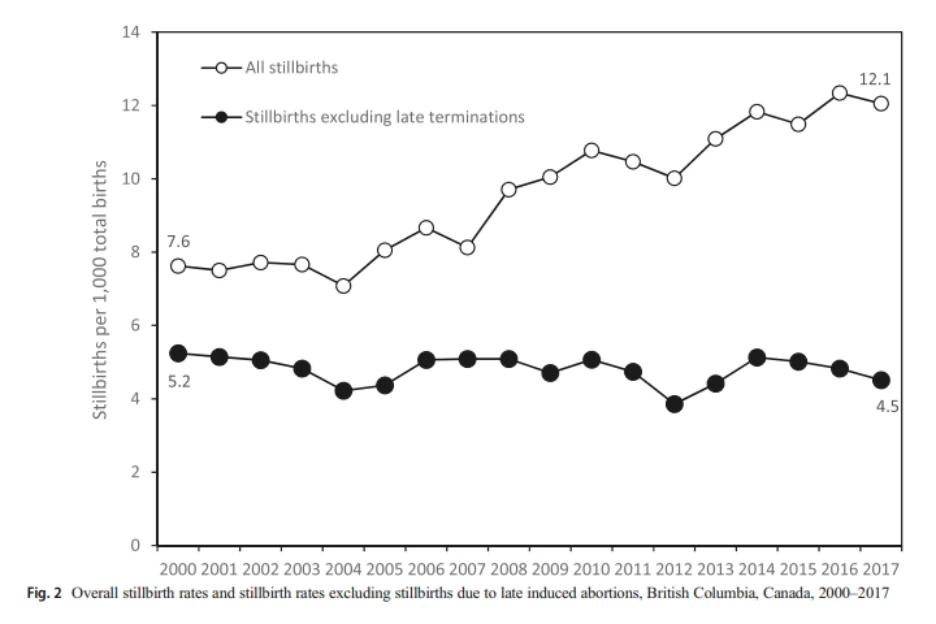
In their academic article, Joseph et al investigated British Columbia’s stillbirth data from 2000 to 2017. They found that the rate of natural stillbirths declined slightly over the years (from 5.2 to 4.5 natural stillbirths per 1000 total births), but the rate of abortion-induced stillbirths rose significantly (from 7.6 to 12.1). Thus, in 2017, nearly three-quarters of all stillbirths in British Columbia were caused by late-term abortions.
The authors raise this not because they have any problem with abortion. Instead, they are concerned that including late-term abortions in stillbirth data makes Canada look bad. Virtually no other country classifies late-term abortions as stillbirths, and so Canada appears to have a far higher rate of stillbirths than other developed countries.
This classification may also contribute to the undercounting of late-term abortions. Using the data in the academic article and publicly available data on the number of annual births in British Columbia, we can estimate that the number of late-term abortions in that province was around 350 in 2017. If a similar rate of late-term abortions were calculated as stillbirths across the rest of Canada, that would be roughly 2,635 late-term abortions across the country in 2017 that were classified as stillbirths.
If indeed every late-term abortion is counted as a stillbirth, then the number of late-term abortions should roughly match the official number of late-term abortions reported by the Canadian Institute for Health Information (CIHI). We recently used their data to estimate the number of late-term abortions in Canada.
The two figures aren’t even close. The estimated number of late-term abortions from the stillborn data tends to be about 50% higher than the number of late-term abortions we estimated from CIHI data (which, in turn, is already quite a bit higher than the officially reported number of late-term abortions).
All of these are rough, back-of-the-napkin estimates that shouldn’t be considered authoritative. But it suggests that many late-term abortions aren’t being reported as abortions but as stillbirths.
Parsing the Language
When Canadians talk about abortion, we usually all mean the same thing. Although pro-life and pro-choice Canadians differ on the moral status of the pre-born child, the activity we are referencing is usually the same.
Until it isn’t.
Pro-life Canadians talk about abortion in moral terms, as ending the life of a pre-born child. Whenever we talk about abortion, this is what we are objecting to. Pro-choice Canadians generally talk about abortion in medical terms, as removing a fetus from the womb. While the two generally go together, they don’t always.
For example, Canadian medical terminology distinguishes between “spontaneous abortion” and “induced abortion.”
Spontaneous abortion is just the medical term for a miscarriage, when the pre-born child dies of natural causes in the womb and is naturally expelled from the body without any medical intervention before the 20th week of pregnancy, in a way similar to a period or a birth.
Although we may be uncomfortable with the language of spontaneous abortion, pro-life Canadians have no moral qualms about such unintentional miscarriages, only sorrow for the loss of the pre-born child.
In some cases, however, a woman’s body does not pass the deceased pre-born child. Instead, the deceased child remains in the uterus. This is often called a missed (or silent) miscarriage. This can jeopardize the health of the mother by causing severe bleeding or infection, so medical professionals often induce labour, perform a caesarean section, or even perform dilation and curettage to remove the deceased child. Some medical professionals or women may consider this an “induced abortion”. For example, many women have pointed out on our social media that they had a “late-term abortion” to expel a pre-child who had already passed away.
Again, in these circumstances, pro-lifers have no moral concerns. Procedures that cause a pre-born child who has already passed away to be delivered are ethically fine, even if that procedure carries the label of abortion. The great moral line of purposely ending the life of a pre-born child has not been crossed.
In most abortions, though, the death of the pre-born child and her expulsion from the womb are part of the same process. For example, the abortion pill is actually two separate pills taken in quick succession. The first pill, Mifepristone, kills the pre-born child. The second pill, Misoprostol, induces contractions to expel the child from the womb soon after. In some surgical abortions, the pre-born child is chemically killed before being ripped from the womb. In other cases, the child may be killed by dismemberment.
This, of course, is what pro-lifers oppose. Any procedure that kills a pre-born child is abhorrent.
As it stands right now, the Canadian definition of stillbirth includes all of the above (unintentional miscarriages as well as intentional abortions) when the pre-born child is at or over 20 weeks gestation.
But language matters.
Our language reveals – or masks – tragedy and injustice.
The child who dies of natural causes and the child who is deliberately killed in the womb are both precious. In one sense, using the term “stillbirth” to describe both highlights the basic similarity between them – both are newly born children who tragically passed away before birth. But people don’t think of abortion when they hear the term stillborn or stillbirth. The term therefore hides a terrible truth and brutal injustice when used to describe a child who was aborted.
We agree with these academics that Canada should stop counting late-term abortions as stillbirths. The stillbirth label should be reserved for pre-born children who pass away naturally.
But we disagree that this is all that our country needs to do. Canada has no legal protections for pre-born children at any stage of pregnancy. We need your help to advocate for laws to protect pre-born children.
Will you join us?