In this report, we briefly review how MAID policy in Canada has developed, the ableist foundation of Canada’s legislative framework, the dangerous gaps in the law, and the lack of effective oversight. We then suggest amendments to Canada’s law to better protect vulnerable Canadians.
When the Supreme Court of Canada struck down the Criminal Code prohibitions on assisted suicide in the 2015 Carter case, it overturned years of legal, medical, and ethical precedents.[1] Parliament responded in 2016,[2] amending the Criminal Code and establishing a framework in which doctors could legally end the lives of some patients.[3] The 2016 law permitted medical professionals to cause a patient’s death by administering a lethal injection (consensual homicide) or by prescribing a lethal drug for the patient to self-administer (assisted suicide). From 2016 to 2021, consensual homicide and assisted suicide were limited to persons whose natural death was “reasonably foreseeable”.
Since March 2021, however, “medical assistance in dying” or “MAID”, as the law calls it, has been available to people who are not dying – to people with non-terminal illnesses or disabilities. Furthermore, people who suffer solely from mental illness are scheduled to be eligible for MAID as of March 17, 2027.
MAID in Canada
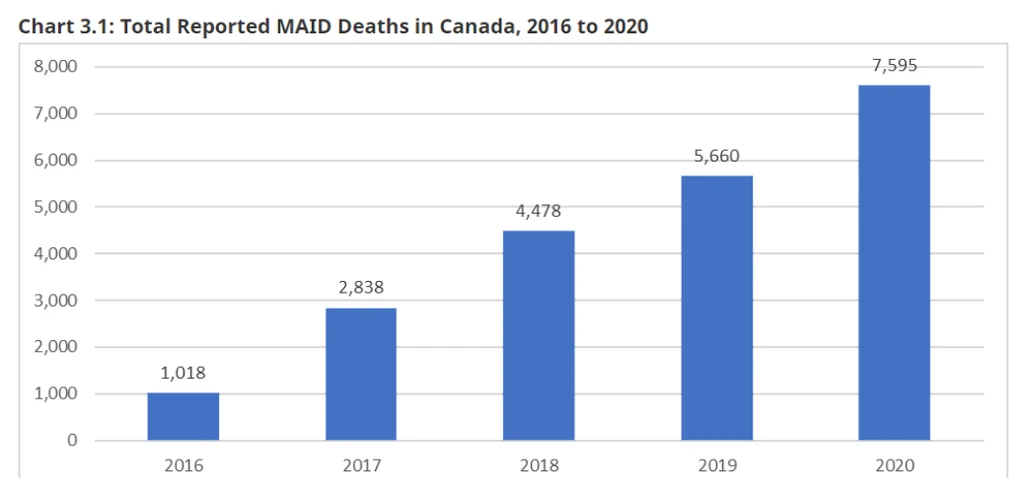
Since it was legalized in 2016, over 100,000 people have died by MAID in Canada.[4] Nearly all (over 99%) were euthanasia deaths, in which a physician or nurse practitioner directly administered lethal drugs (as opposed to assisted suicide, where a person self-administers the lethal drugs).[5]
The Supreme Court of Canada, in its 2015 ruling in Carter, began and ended its judgment by noting how narrow the scope of the ruling was intended to be – namely, that it related only to adult persons with debilitating, terminal conditions who were nearing death.[6]
Justice Lynn Smith, the trial judge in Carter, had found that the “inherent” risks of legalizing MAID could be “substantially minimized” (although not eliminated) through a “carefully-designed system imposing stringent limits that are scrupulously monitored and enforced.”[7] Justice Smith asserted this despite evidence that safeguards often go ignored in every jurisdiction that has legalized MAID.[8] Canada’s MAID law, even on paper, never satisfied the stringent limits and scrupulous enforcement that Justice Smith envisioned.
But the law was weakened even further. In 2019, a lower-court judge in Quebec ruled[9] that people with disabilities who were not dying should also be eligible for MAID.[10] Rather than appeal this decision, the federal government used it as a pretext to further expand MAID.
Predictably, MAID deaths have increased rapidly each year.[11] MAID is no longer treated as a last resort in extreme situations, but as a solution to all kinds of suffering.
In 2018, Health Canada predicted that MAID deaths would stabilize at around 2.05% of all deaths. In 2019, MAID deaths accounted for 2% of all deaths. In May of 2022, Health Canada updated its prediction to say that by 2033, MAID deaths would stabilize at 4% of all deaths. But Canada passed the 4% threshold already by late 2022.[12] MAID now accounts for more than 1 in every 20 deaths in Canada.[13]
Patients in Canada have received MAID despite unaddressed mental illness, housing insecurity, and lack of social support. A London, Ontario man was deemed eligible for MAID due to inflammatory bowel disease. He also had a history of mental illness and suicidality, suffered from addiction, and was socially isolated and vulnerable. Not only was he offered euthanasia by his psychiatrist, but he was assessed at a Tim Hortons and driven to his MAID death by his MAID provider.[14]
Another Canadian suffered from severe ulcers, multiple mental illnesses, and chronic suicidal ideation. He had attempted suicide just a year prior to dying by MAID.[15] Ontario’s MAID Death Review Committee, which reviews complex MAID cases in that province, has noted the “importance of addressing and resolving suffering in contrast to procedurally qualifying for a MAID death.”[16] Many patients are being offered death rather than the help they need to live well.
In 2025, the United Nations Committee on the Rights of Persons with Disabilities condemned Canada’s MAID regime and recommended that Canada (a) repeal MAID for non-terminal conditions, including mental illness (b) not expand MAID to mature minors or legalize advance requests, (c) invest in supports, (d) strengthen consultations with Indigenous Peoples, and (e) implement better independent oversight.[17]
Weak safeguards
Instead of a strictly limited, scrupulously monitored system, Canada’s MAID law is lax, vague, and largely unenforced.
In 2021, Parliament eliminated waiting periods for persons whose natural death is “reasonably foreseeable”[18] (a vague term that certain doctors have interpreted as meaning the patient is likely to die within a decade[19]), cut the requirement for witnesses down from two to one, and made it easier to qualify as a witness.[20] In 2023, in Ontario, 65 MAID deaths occurred the same day as the MAID request, and 154 occurred the next day. Ontario’s MAID Death Review Committee found that some eligibility assessments lacked rigour. In others, medical assessments of patients’ decision-making capacity often did not meet professionalism standards. The Committee even found cases in which patients were euthanized after medical staff determined that they lacked capacity.[21]
Canadian law does not prohibit medical staff from proactively offering MAID to patients who have not asked for or about it.[22] Health Canada’s 2023 Practice Standard for MAID even suggests advising patients about MAID if it is “consistent with the person’s values and goals of care.”[23] Proactively offering MAID causes distress to many patients, who receive the implied message that medical staff think they might be better off dead.
Counselling someone to commit suicide remains a crime in Canada,[24] but aiding suicide remains a crime only outside the MAID context. Patients look to their physicians for advice and guidance about the best treatment option for them. Suggesting, as a medical professional, that a patient consider MAID is ethically indistinguishable from counselling a person to consider suicide.
Before 2016, assisting suicide and homicide were serious criminal offences in Canada.[25] Parliament’s response to the Supreme Court’s Carter decision allows medical professionals to intentionally kill their patients in certain circumstances as exceptions to Criminal Code prohibitions on homicide and assisted suicide. However, MAID remains homicide – “causing the death of a human being” – under the Criminal Code.[26]
The question in every situation where MAID is administered is whether the homicide is culpable or not culpable.[27] This is a legal, not merely a medical, question. A 2024 UK bill to legalize euthanasia recognized this and would have required a review panel including a person who has held high judicial office to review every euthanasia request. Though the UK bill was far more restrictive than Canada’s law and included major safeguards that Canada lacks, the House of Lords filed more than 1,200 amendments to the bill and it did not pass prior to the end of the Parliamentary session.[28]
Lack of enforcement
The Ontario Coroner’s MAID Death Review Committee has noted compliance problems such as failing to apply the 90-day waiting period and not ensuring the patient was assessed by a doctor with expertise in their condition. In at least one case, some committee members believed the patient suffered solely from mental illness and thus should not have been deemed eligible for MAID.[29]
Other provinces have similar problems. According to a report of the British Columbia Ministry of Health, more than half of all MAID cases in 2024 were missing information or needed existing information clarified. In 353 of these cases, concerns were raised about compliance with the law.[30]
In 2024-25, the Quebec commission on end-of-life care found 19 cases of possible non-compliance. In 10 of these, the commission believed that the patient did not have a serious and incurable illness – a key eligibility requirement.[31]
Medical professionals who violate Criminal Code safeguards are rarely disciplined by the regulatory college or investigated by law enforcement. For example, from 2018-2023, only four of 428 cases of possible criminal violations tracked in Ontario were reported to the regulatory college, and none were referred to law enforcement. In 2023 alone, the coroner’s office identified 178 cases of possible noncompliance. Further, a quarter of all euthanasia providers heard from the provincial coroner’s office at least once about a compliance issue.[32] In 2024, coroner’s investigations were started in 299 cases in Ontario.[33]
In the extremely rare instances of professional discipline, the penalties are light compared to the magnitude of the infractions. For example, a College investigation of one Ontario doctor found that his conduct “exposes or is likely to expose patients to harm or injury in five out of twenty [patient] charts reviewed”. Yet the doctor was simply placed under six months of supervision – essentially a slap on the wrist.[34]
MAID and ableism
Canada’s MAID law codifies the idea that it is permissible to intentionally kill a person who asks to be killed, provided they no longer possess the qualities or capabilities that society deems necessary for sufficient “quality of life.” In other words, it is okay for some people – medical doctors and nurse practitioners – to decide whose life is worth living and to offer either suicide assistance or suicide prevention based on their assessment.
The foundational ethic of human rights cares for – and does not kill – the weak, sick, disabled, and elderly.[35] We find this in the biblical sixth commandment[36] and in the Hippocratic Oath.[37] We find it in the prohibitions on killing found in every nation’s criminal laws today, in the continued prohibition on assisted death in most nations, and in the continued prohibition in Canada on counselling a person to commit suicide.[38]
Yet Canada’s MAID law ignores the concerns of “voices from the margins”[39] – disability rights advocates, mental health advocates, suicide prevention advocates, Indigenous groups, religious groups, and advocates for the elderly.[40] Canada’s current euthanasia regime represents the preferences of the able-bodied majority.
The law creates a value divide between able-bodied Canadians, who are offered suicide prevention, and disabled Canadians, who are offered suicide assistance. The law disregards the principle of equal, inherent human dignity, and the equal protection of the law for all. Having abandoned the rule of the inviolability of human life, Canada struggles to find a principled basis for distinguishing between persons who may or may not be killed when they ask to be. Consequently, the basis for the distinction is the variable discretionary judgments of a given doctor who considers a person’s quality of life to be sufficiently bad to merit MAID.
This legal shift has cultural impacts. As MAID becomes normalized, medical staff may begin to see MAID-eligible patients who go on living as a drain on resources.[41] Indeed, the MAID-eligible elderly, sick, or disabled begin to see themselves that way, as the data shows. Of those who requested and received MAID in 2024, nearly 50% believed they were a burden on family, friends, or caregivers.[42] Additionally, doctors may overlook patients’ social, situational, and economic suffering and assume that physical pain is their reason for requesting MAID.[43]
Proactively offering MAID to sick and disabled patients exacerbates their perception that their suffering is intolerable and their lives not worth living. Krista Carr, CEO of Inclusion Canada, noted at a Parliamentary Committee that she hears weekly about people with disabilities being offered MAID when they are seeking completely different services. This has changed the experience of people with disabilities when they interact with the healthcare system and has caused many to fear showing up in the healthcare system with regular health concerns.[44]
MAID and mental illness
Another cultural impact of legalizing MAID is normalizing suicide itself. After all, if assisted suicide is a “dignified” way to die, why not unassisted suicide? Despite the high rates of medically-assisted deaths in Canada, suicide rates have remained relatively stable since Canada legalized MAID.[45] This is particularly striking in light of pro-MAID arguments that MAID availability helps to prevent suicide. The Chief Medical Officer of Canada’s suicide prevention helpline recently noted that there is an overlap between people experiencing suicidality and those considering MAID. In fact, 7% of calls to the helpline mention MAID.[46] Dr. Crawford warns that MAID and suicide are not properly discussed in public and in the media and that this increases the risk “that people will see MAID as a means of alleviating their mental suffering and this will undermine suicide prevention efforts.”[47]
Publicized suicides often inspire more suicides in a given area, which tend to be completed by similar means, especially by persons in a similar demographic as the victim in the publicized suicide.[48] Consequently, news media follow guidelines for reporting on suicide in a way that minimizes copycat or contagion effects.[49] No such guidelines exist in relation to MAID. Many media outlets report MAID stories positively.[50]
Fears of suicide contagion are especially relevant when it comes to MAID where mental illness is a factor. Dutch psychiatrists report that “introducing euthanasia as a sanctioned outcome reframes suicidality from a symptom requiring containment into a potential treatment endpoint, an acceptable ‘treatment plan.’”[51]
MAID for mental illness as the sole underlying medical condition has been looming in Canada since 2021 but has been delayed until March 17, 2027. MAID for mental illness would normalize death as a “solution” for mental suffering and undermine suicide prevention efforts. Over a dozen current and former chairs of psychiatry departments across Canada warn that there is no broadly accepted definition of irremediability in cases of mental illness, no clear way to distinguish between suicidality and MAID requests, and inadequate safeguards to protect the vulnerable.[52]
In the Netherlands, which has permitted psychiatric euthanasia for over two decades, cases of psychiatric euthanasia have increased rapidly in recent years, from two cases in 2011 to 219 in 2024. Even assuming that psychiatric euthanasia is not a form of suicide, it in no way prevents suicides. The result of legalizing psychiatric MAID is that more people from mental illness will die, whether by their own hand or a doctor’s.[53]
MAID for mental illness already occurs in Canada
MAID for mental illness is already happening in Canada – in cases where patients with mental illness also have another condition rendering them eligible for MAID. If a person experiences psychological suffering that is connected to a physical illness or disability, then they are eligible for MAID under Canadian law.
In 2024, men were more likely than women (52% to 48%) to receive MAID under “Track 1” (reasonably foreseeable natural death). Women were more likely to die by “Track 2” MAID (natural death not reasonably foreseeable), at nearly 57%.[54] And when it comes to psychiatric euthanasia in the Netherlands, women access euthanasia at nearly twice the rate of men,[55] which mirrors the disparity between the sexes in suicide attempts.[56] In the Netherlands, one group of researchers concludes “that the availability of [psychiatric euthanasia] in the Netherlands may render more effective the wish to die of women whose suffering from mental illness is unbearable.”[57] The higher rate of women accessing Track 2 MAID in Canada raises concerns about whether women are using MAID as a highly effective means of suicide.
Many Canadians have been deemed eligible for and received MAID due to physical disabilities or illness, while also suffering from mental illness. Kiano Vafaeian was a young man with diabetes and vision loss. He was also depressed. Though several MAID assessors had found him ineligible for MAID, Vafaeian was euthanized in British Columbia in late 2025, once he managed to find a doctor who deemed him eligible.[58]
Canada should support suicide prevention for everyone at any stage of life. Anything else requires judging the worth, or supposed lack thereof, of a person’s life. The Supreme Court fallaciously found there are only two options when facing suffering: end your own life early or suffer until you die.[59] As Psychiatrist John Maher notes, “The argument that somehow a messy death justifies supporting [medically assisted] suicide misses the point completely. What it justifies is treatment to prevent getting to a messy death in the first place.”[60] People can find meaning in and through suffering. And thankfully, the means available for reducing suffering have also advanced significantly. Physical and psychological suffering can be alleviated, if not eliminated, through pain management, palliative medicine, and counselling. Sadly, many Canadians do not know the value of palliative care.[61]
License to kill: the deadly allure of advance requests
Despite widespread problems with MAID in Canada, pro-euthanasia advocates agitate for further expansion, including by allowing advance requests. Such requests would allow a person, particularly someone with an illness that will lead to incapacity, who does not currently want to die by MAID, to outline specific circumstances under which they would want to be euthanized in the future. Quebec has already moved ahead with advance requests, in direct violation of the Criminal Code. While Canada’s current law permits consensual homicide, advance requests would legalize a form of nonconsensual homicide.
A person may make an advance request based on the present fear of a future condition (e.g. advanced dementia) that they have never experienced. But they might not, when that future condition arrives, actually wish to die. They may live well despite their condition and reduced mental capacity. Yet, when the time comes, they may be incapable of revoking their advance request or communicating that they have no wish to die.
Advance requests grant doctors a license to kill, which takes legal effect when, in the doctor’s opinion, the patient has reached the condition described in the request. Given the patient’s loss of capacity by that point, he is unable to confirm or deny the doctor’s opinion.
As with suggesting MAID to a patient, if doctors suggest that a patient consider an advance request, it sends a message that life is not worth living once you have severely reduced mental capacity. This devalues the lives of such persons and causes others to fear becoming like them.
Advance requests allow for the subtle manipulation and abuse of those who may lose decision-making capacity. Elderly people at risk of losing capacity may sign documents they do not understand due to external pressures.[62]
While advance requests remain prohibited in Canada, patients with dementia and other neurocognitive conditions are eligible for euthanasia. Persons with dementia reported far lower rates of inadequate pain control, but higher rates of loss of dignity, being a perceived burden on family, friends, or caregivers, and experience of isolation and loneliness than those with other conditions. Such factors indicate that people need social and mental health supports, not euthanasia.[63]
Sadly, in some cases, medical professionals have failed to confirm consent before administering euthanasia. A recent report noted that 103 patients with dementia were euthanized in 2023 and 2024 in Ontario. One woman who died by MAID had advanced dementia, which often renders a person incapable of providing informed consent. The MAID eligibility assessment included an inadequate evaluation of cognitive impairments, despite her challenges with navigating daily routines. She had expressed a wish to die to a family member, who made a request for MAID to the care team. She later chose to move to long-term care instead. A few months later, a family member again initiated a referral for MAID. When this woman was euthanized, final consent was supposedly determined by her ability to repeat the consent question and squeeze the MAID provider’s hand.[64]
We are all vulnerable
In 2024, the vast majority (over 95%) of Canadians requesting MAID cited their loss of ability to engage in meaningful activities as a reason for choosing MAID, while nearly half cited feeling like a burden to loved ones.[65] Of those whose death was reasonably foreseeable, 21.9% cited isolation and loneliness. For those whose death was not reasonably foreseeable, that jumped to 44.7%. People typically have several reasons for seeking MAID, the most predominant of which are based not on physical pain, but on existential, spiritual, social, or psychological suffering.
Some Canadians have been pressured into choosing MAID. One family was horrified to learn that their mother, Joan, was offered MAID while in the hospital, alone, and in a heavily medicated state. She accepted the offer, but her family advocated for her and brought her home for palliative care, at which point Joan was able to say, regarding MAID, “Absolutely not. I want to live.”[66]
Dr. Margaret Somerville, founding director of the Centre for Medicine, Ethics and Law at McGill University, says the Supreme Court of Canada’s notion that suicide is freely chosen so long as the person is competent and not subject to coercion represents an extremely myopic understanding of vulnerability.[67] The United Nations Committee on the Rights of Persons with Disabilities stressed that the concept of autonomous “choice” oversimplifies matters. There are many social factors that contribute to that choice.[68] Social, psychological, and emotional factors are at play in every end-of-life decision.
Canada has moved swiftly from discussing euthanasia exclusively for terminally ill, near-death patients who request it, as proposed in the Carter case, to proactively offering it as an option to those with any serious illness or disability. Yet some contend that euthanasia should also be an option for people with advanced dementia who can no longer confirm their consent,[69] or for teenagers with cancer,[70] paralysis, or depression, or even for babies with severe birth defects, at their parents’ request.[71] Opening the door to MAID transforms our conception of suicide from “a tragedy we should seek to prevent to a release from suffering we should seek to assist.”[72]
The legal availability of euthanasia and medically assisted suicide shifts the societal discussion from how to alleviate suffering to which sufferers can be eliminated. It demonstrates a profound lack of compassion toward the most vulnerable Canadians: the elderly, the sick, the chronically depressed, those with disabilities, and the lonely. Even if a person has the requisite “grievous medical condition,” her desire to die may be the result of a complex web of factors including hopelessness, fear, loneliness, shame, conflict with family members, emotional abuse, lack of access to palliative care, and so on.[73] Canada supposedly allows euthanasia to grant people greater autonomy over their end-of-life experience, but this comes at the expense of loving, life-affirming care.
Every person is inherently worthy of protection by law, regardless of physical or mental limitations.[74] The sanctity of human life is the foundation for human rights and equality under the law.[75] If individual autonomy trumps the sanctity of life, the most dependent among us are at risk.[76] Legalizing euthanasia or assisted suicide does not enhance the autonomy of suffering individuals. The legal change only provides a new criminal defence for medical professionals who take the lives of suffering people. The decision over who qualifies for state-sponsored death is made by society, through the law, and by the doctors and nurse practitioners who interpret that law – not by ‘autonomous individuals.’[77]
Canada has chosen a system that expedites death for the vulnerable. Now, the federal government must stop further expansion and instead protect vulnerable Canadians.
Policy recommendations
Canada’s current law places vulnerable people at risk and fails to affirm the intrinsic worth of all human beings.
ARPA Canada respectfully calls on Parliament to do everything in its power to uphold the intrinsic worth of all human life. The government crossed a sacred line by passing legislation permitting euthanasia. It ought not to continue expanding access to this extreme measure. Parliament should amend Canada’s current permissive law to better protect those most vulnerable to abuses.
Recommendation #1: Eradicate ableism – The only way to ensure that MAID is not an ableist program is to decouple it from disability and reserve it as an option that is strictly limited to those who are suffering at the end of their lives. Parliament can do so by:
- amending the eligibility criteria in section 241.2(2) by adding “(d) a medical practitioner with expertise in the condition that is causing the person’s suffering provides a written opinion that the person’s prognosis of natural death is six months or less” and
- deleting subsection 241.2(3.1) (safeguards for persons whose death is not foreseeable).
Failing that, “reasonable foreseeability of death” must be clarified to mean a patient has a prognosis of natural death within six months, in order to address the appalling abuse of the term and the “fast tracking” of patients who have years left to live.
Recommendation #2: No further expansion – In addition to precluding mental illness as a sole underlying condition from MAID eligibility, Parliament must not legalize nonconsensual homicide through advance requests. Allowing advance requests encourages a culture of neglect for patients with neurocognitive conditions. Instead, the federal government should challenge Quebec’s disregard of the Criminal Code prohibition on advance requests.
Recommendation #3: Prohibit inducing suicide – Counseling a person to consider suicide remains a crime in all circumstances. Therefore, counselling or encouraging a person to seek a “medically assisted death” should be prohibited, and medical personnel should be prohibited from mentioning or discussing MAID with a patient unless the patient explicitly asks.
Parliament must reinforce the prohibition in section 241(1)(a) – counseling to commit suicide – by clarifying that medical professionals may only provide information about the provision of medical assistance in dying upon request.[78] Section 241(5.1) should be amended to state: “For greater certainty, no social worker, psychologist, psychiatrist, therapist, medical practitioner, nurse practitioner or other health care professional commits an offence if they provide information to a person on the lawful provision of medical assistance in dying upon the person’s request.”
Recommendation #4: Initiate a comprehensive review of MAID in Canada – Considering evidence of abuses in Canada and other jurisdictions, Parliamentarians should study issues related to the vagueness and permissiveness of the current law. To fully understand the scope and extent of these problems, the federal government should begin a comprehensive review of MAID in Canada and its effects. Canada’s initial MAID legislation in 2016 required such a review after five years, but a comprehensive review was never undertaken.
Recommendation #5: Strengthen safeguards
- Provide alternative options: Require that all other reasonable treatment options be pursued – It is not enough that a patient has been “offered consultations” with other professionals. A patient must have tried all reasonable treatment options before being permitted to access MAID, so that MAID is truly a last resort.
- Increase waiting periods – Amend section 241.2(3) to reinstate a minimum 10-day waiting period for all MAID requests. And if MAID for those whose deaths are not reasonably foreseeable is not repealed, amend section 241.2(3.1)(i) to extend the waiting period for those whose death is not reasonably foreseeable to 180 days, or 6 months.
- Clarify the waiting period – The existing waiting period (for Track 2 MAID) is ambiguous, given that it begins on the day the doctor begins to assess a patient’s eligibility, not the day a written request for MAID is signed. A straightforward amendment would be to add a clarification in subsection 241.2(3.1)(i) that the waiting period begins the day the patient makes a written, signed, dated, and witnessed request for MAID.
- Enhance witness safeguards – Reinstate the two independent witnesses requirement in section 241.2(3)(c) and 241.2(3.1)(c) and require that witnesses must be present when MAID is performed (not just when the written request is signed).
Recommendation #6: Eliminate waiver of consent – Section 241.2(3.2) allows for a patient to make a “written arrangement” granting medical practitioners the authority to unilaterally decide when a patient has lost capacity to give or withhold consent to medical care and to then kill the patient at that time (provided capacity is lost before a date specified in the written arrangement). Unlike a written request for MAID, which requires one witness, this subsequent “written arrangement” requires no witness or second medical opinion.[79]
Recommendation #7: Improve oversight – Establish an independent federal oversight body to review MAID approvals. Every approved MAID request must be reviewed by a medical professional and a legal expert before MAID is administered. The reviewers must agree on eligibility and ensure safeguards have been applied.[80] Additionally, the oversight body must include a mechanism to review cases of possible non-compliance and hear complaints from family members and loved ones. Adding oversight protects against cluster effects based on rogue doctors who interpret the rules liberally or play loose with safeguards and eligibility criteria.
Recommendation #8: Prohibit compelled participation in homicide or suicide – Section 241.2(9) states, “For greater certainty, nothing in this section compels an individual to provide or assist in providing medical assistance in dying.” To provide more teeth to section 241.2(9) and to protect conscience rights and the integrity of the medical profession, Parliament should add a further clarifying section: 241.2(9.1) “For greater certainty, any person who compels an individual to provide or assist in providing medical assistance in dying is guilty of (a) an indictable offence and liable to imprisonment for a term of not more than 5 years; or (b) is guilty of an offence punishable on summary conviction.”
Endnotes:
[1] Carter v. Canada (Attorney General), [2015] 1 SCR 331, 2015 SCC 5.
[2] Bill C-14, (42-1) Statutes of Canada, June 17, 2016.
[3] Criminal Code (R.S.C., 1985, c. C-46), sections 241(2) – 241.4.
[4] Tristin Hopper, “Canada likely to mark 100,000th MAID death by summer,” National Post, February 24, 2026.
[5] Health Canada, Sixth Annual Report on Medical Assistance in Dying in Canada, Government of Canada, November 2025.
[6] Carter v. Canada, supra note 1, at para. 56 and 127. As ARPA Canada and others have consistently maintained, Carter did not force Parliament to permit euthanasia or assisted suicide. Rather, Parliament could have redrafted the law to comply with the Charter. See ARPA Canada, Protecting Life: How Parliament Can Fully Ban Assisted Suicide Without Section 33, September 2015, at p. 4.
[7] Para. 883, as cited in Carter v. Canada (Attorney General), 2015 SCC 5 at paras. 27 and 105.
[8] Carter v. Canada (Attorney General), 2012 BCSC 886 at paras. 649-671.
[9] Truchon v Canada (Attorney General), 2019 QCCS 3792.
[10] The term “Medical Aid in Dying” or “MAID” is an intentionally misleading euphemism and confuses genuinely ethical aid in dying like palliative care with a form of homicide (physician-assisted suicide and/or euthanasia). We object to the euphemism and only refer to it in this report due to the prevalence of the term in medicine, law, and public discourse.
[11] Health Canada, “Sixth Annual Report on Medical Assistance in Dying in Canada,” Government of Canada, November 2025.
[12] Alexander Raikin, “From Exceptional to Routinehttps://www.cardus.ca/research/health/reports/from-exceptional-to-routine/: The Rise of Euthanasia in Canada,” Cardus, August 7, 2024.
[13] Health Canada, “Sixth Annual Report on Medical Assistance in Dying in Canada,” Government of Canada, November 2025.
[14] MAiD Death Review Committee (MDRC) Report 2024 – 3, “Navigating Vulnerability in Non-Reasonably Foreseeable Natural Deaths,” Ministry of the Solicitor General, at pp. 15-19; see also Kathryn Blaze Baum and Nancy MacDonald, “Ontario doctor cautioned over MAID complaints can continue practice under supervision, regulator rules,” The Globe and Mail, May 25, 2026.
[15] MAiD Death Review Committee (MDRC) Report 2024 – 2, “Complex Medical Conditions with Non-Reasonably Foreseeable Natural Deaths,” Ministry of the Solicitor General, at pp. 13-14.
[16] MAiD Death Review Committee (MDRC) Report 2024 – 3, “Navigating Vulnerability in Non-Reasonably Foreseeable Natural Deaths,” Ministry of the Solicitor General, at p. 21.
[17] Committee on the Rights of Persons with Disabilities, “Concluding observations on the combined second and third periodic reports of Canada,” United Nations, at pp. 7-8.
[18] Dr. Madeline Li, expert witness in the Lamb case in the B.C. Supreme Court (Lamb v. Canada (Attorney General), 2017 BCSC 1802) developed and oversees the MAID program at the University Health Network in Toronto. She notes in her expert report that psychological suffering is the main reason for assisted dying requests in all jurisdictions where it is legal (para. 6 on p. 5). Dr. Li describes the case of a woman who had bone cancer and a history of chronic depression (see paras. 20-21). This patient was assessed by two “experienced MAID providers” (not by her oncologist or psychiatrist) who approved her for MAID. After her 10-day waiting period, she changed her mind and decided to pursue a palliative approach. Later, during another medical crisis, she requested MAID again. Her MAID physician decided that there were no concerns about her apparent ambivalence. But two days before her planned MAID intervention, she changed her mind again and agreed to undertake new cancer therapies. This illustrates, Dr. Li says, the difficulty of accounting for the influence of anxiety or depression and other factors in a patient’s request for MAID. It also demonstrates the importance of waiting periods, and of offering all possible supports to a patient. Air Canada and other airlines give you 24 hours to cancel your flight penalty-free. Bill C-7, however, would permit a person to request MAID and be euthanized the same day or hour. It is not at all clear why the government thought deleting this safeguard was necessary.
[19] Dr. Wiebe, who has euthanized several hundred people, says she goes by a roughly 10-year prognosis – a very loose standard from a scientific and medical perspective. See Joan Bryden, “Experts Concerned Ottawa has revived uncertainty over meaning of foreseeable death in assisted dying bill,” Globe and Mailhttps://www.theglobeandmail.com/politics/article-experts-concerned-ottawa-has-revived-uncertainty-over-meaning-of/, March 3, 2020.
[20] Criminal Code (R.S.C., 1985, c. C-46), sections 241.2(3)(c).
[21] MDRC Report 2024 – 4: Complex Same Day/Next Day Provisions, “Navigating Complex Issues within Same Day and Next Day MAiD Provisions,” Ministry of the Solicitor General, at p. 7. See also Ramona Coelho, David Shannon, and Trudo Lemmens, “MAiD capacity and consent standards must be rigorously upheld,” MacDonald Laurier Institute, December 1, 2025.
[22] See for example Christa Dao and Elizabeth McSheffrey, “She went to the hospital with suicidal thoughts. A clinician raised medically-assisted death,” Global News, August 10, 2023; Terry O’Neill, “MAiD raised with Vancouver priest during hospital care – twice,” The B.C. Catholic, April 21, 2026; Sharon Kirkey, “This B.C. woman was offered MAID before other treatments. She said no to death and went on to climb a volcano,” National Post, March 27, 2026; Sharon Kirkey, “Nova Scotia woman was asked if she knew about assisted dying before mastectomy surgery for breast cancer,” National Post, October 22, 2024.
[23] Health Canada, “Model Practice Standard for Medical Assistance in Dying (MAID),” Government of Canada, March 2023.
[24] Criminal Code (R.S.C., 1985, c. C-46), s.241(1)(a), which states, “Everyone is guilty of an indictable offence and liable to imprisonment for a term of not more than 14 years who, whether suicide ensues or not, (a) counsels a person to die by suicide or abets a person in dying by suicide”. This section has no exemptions in the provisions for MAID and remains absolutely prohibited.
[25] In the 2015 Carter v. Canada (Attorney General) decision, the Supreme Court of Canada struck down the absolute prohibition on assisted suicide in s. 241 of the Criminal Code and on consenting to homicide in s. 14.
[26] Criminal Code (R.S.C., 1985, c. C-46), section 222(1) states, “A person commits homicide when, directly or indirectly, by any means, he causes the death of a human being.”
[27] Criminal Code (R.S.C., 1985, c. C-46), s. 222(1)-(5). See also s.227, which states at (1): “No medical practitioner or nurse practitioner commits culpable homicide if they provide a person with medical assistance in dying in accordance with section 241.2.” Note the word “if”, which distinguishes between culpable and non-culpable homicide.
[28] ”Assisted dying bill will not become law in current session of U.K. Parliament,” CBC News, April 24, 2026.
[29] MAiD Death Review Committee (MDRC) Report 2024 – 2, “Complex Medical Conditions with Non-Reasonably Foreseeable Natural Deaths,” Ministry of the Solicitor General, at p. 11; MAiD Death Review Committee (MDRC) Report 2024 – 3, “Navigating Vulnerability in Non-Reasonably Foreseeable Natural Deaths,” Ministry of the Solicitor General, at pp. 19-21.
[30] Terry O’Neill, “Thousands of errors found in B.C. MAiD cases, internal report shows,” Canadian Catholic News, July 5, 2026.
[31] Commission sur les soins de fin de vie, “Rapport Annuel d’Activités,” Du 1 er avril 2024 au 31 mars 2025, at p. 9.
[32] Alexander Raikin, “A Pattern of Noncompliance,” The New Atlantis, November 11, 2024.
[33] Meagan Gillmore, ”Ontario report questions MAID approvals for patients refusing treatment,” Canadian Affairs, August 27, 2025.
[34] Nancy MacDonald and Kathryn Blaze Baum, “Experts split on MAID oversight after Ontario lets disciplined doctor continue practice,” The Globe and Mail, May 28, 2026.
[36] Exodus 20:13 and Deuteronomy 5:17.
[37] Greek Medicine, “The Hippocratic Oath”.
[38] Criminal Code (R.S.C., 1985, c. C-46), section 241(1)(a).
[39] “Voices from the Margins” is a term used by the Vulnerable Persons Standard, which promotes five evidence-based safeguards to protect the lives of vulnerable Canadians in a society where MAID is legal.
[40] A review of the submissions made to the Parliamentary committees studying Bills C-14 (42-1) and C-7 (43-2), and subsequently the Special Joint Committee on Medical Assistance in Dying (AMAD) show a clear majority of disability groups and their allies urging restraint.
[41] Charles Lewis, “The burden of mercy,” The National Post, November 30, 2007. See also Factum of the Council of Canadians with Disabilities in the Carter Case at the Supreme Court of Canada, particularly paras. 26-38.
[42] Health Canada, Sixth Annual Report on Medical Assistance in Dying in Canada, Government of Canada, November 2025.
[43] Ramona Coelho, “Disability and MAiD,” in Ramona Coelho, K. Sonu Gain, and Trudo Lemmens, eds., Unravelling MAiD in Canada, (Montreal: McGill-Queen’s University Press, 2025), 191-192; 195.
[44] Standing Committee on Finance, “Evidence,” House of Commons, October 8, 2025.
[45] Government of Canada, “Suicide, self-harm, and suicide-related behaviours in Canada,” January 12, 2026.
[46] Report of the Special Joint Committee on Medical Assistance in Dying, “Medical Assistance in Dying and Mental Disorder as the Sole Underlying Medical Condition: A Complex and Challenging Conversation Among Canadians,” June 2026.
[47] Suicide Crisis Helpline, “Submission to the Special Joint Committee on Medical Assistance in Dying,” April 27, 2026.
[48] See for example Soo Ah Jang et al., “Copycat suicide induced by entertainment celebrity suicides in South Korea,” Psychiatric Investigation 13, no. 1 (2015):, 74-81; and S. Stack, “Media coverage as a risk factor in suicide,” Journal of Epidemiology and Community Health 57 (2003): 238-240.
[49] Mark Sinyor et al., “Media Guidelines for Reporting on Suicide: 2017 Update of the Canadian Psychiatric Association Policy Paper,” May 3, 2017;
[50] See for example Rachel Cave, “Married 41 years and racked with pain, N.B. couple said goodbye together using MAID,” CBC News, March 25, 2025; Tara Bowie, “B.C. man chooses death with dignified party – music, whisky and cigars included.” The Abbotsford News, March 6, 2019.
[51] Jim van Os, Wilbert van Rooij, and Mark Komrad, “Psychiatric Euthanasia in the Netherlands: Young People, Procedural Medicine, and the Limits of Psychiatry,” Psychiatric Times, March 5, 2026.
[52] Jitender Sareen et al., “Written Brief Submitted to the Special Joint Committee on Medical Assistance in Dying and Ministers of Parliament,” April 20, 2026.
[53] Jim van Os, et al., “Psychiatric Euthanasia in the Netherlands: Young People, Procedural Medicine, and the Limits of Psychiatry,” Psychiatric Times, March 5, 2026.
[54] Health Canada, Sixth Annual Report on Medical Assistance in Dying in Canada, Government of Canada, November 2025.
[55] Monique Kammeraat et al., “Patients requesting and receiving euthanasia for psychiatric disorders in the Netherlands,” BMJ Ment Health 26 (2023): 1-8. See also Marie E. Nicolini, Chris Gastmans, and Scott Y.H. Kim, “Psychiatric euthanasia, suicide and the role of gender,” British Journal of Psychiatry 220, no. 1 (2022): 10-13.
[56] Lakshmi Vijayakumar, “Suicide in women,” Indian Journal of Psychiatry 57, no. 2 (2015): 233-238.
[57] Kammeraat et al., “Patients requesting and receiving euthanasia for psychiatric disorders in the Netherlands,” BMJ Ment Health 26 (2023): 1-8.
[58] Rupa Subramanya, “Determined to Die,” The Free Press, January 26, 2026.
[59] The fallacy is most obvious in the Supreme Court’s opening paragraph in the Carter decision (emphasis added), “It is a crime in Canada to assist another person in ending her own life. As a result, people who are grievously and irremediably ill cannot seek a physician’s assistance in dying and may be condemned to a life of severe and intolerable suffering. A person facing this prospect has two options: she can take her own life prematurely, often by violent or dangerous means, or she can suffer until she dies from natural causes. The choice is cruel.”
[60] Report of the Special Joint Committee on Medical Assistance in Dying, “Medical Assistance in Dying and Mental Disorder as the Sole Underlying Medical Condition: A Complex and Challenging Conversation Among Canadians,” June 2026.
[61] ”Care gap: Nearly all Canadians would want palliative care when needed; fewer confident they’d be able to access it,” Angus Reid, May 4, 2026.
[62] Catherine Ferrier, “MAiD by Advance Request,” in in Ramona Coelho, K. Sonu Gain, and Trudo Lemmens, eds., Unravelling MAiD in Canada, (Montreal: McGill-Queen’s University Press, 2025), at pp. 451-468.
[63] MAiD Death Review Committee (MDRC) Report: 2025 -2, “Navigating MAiD with Persons with Dementia,” Ministry of the Solicitor General, at p. 9.
[64] Ibid., at pp. 32-35.
[65] Health Canada, Sixth Annual Report on Medical Assistance in Dying in Canada, Government of Canada, November 2025.
[66] Terry O’Neill, “Elderly cancer patient was pushed toward euthanasia, family says,” BC Catholic, June 28, 2021.
[67] Margaret Somerville, “What the top court left out in judgment on assisted suicide,” The Globe and Mail, Published October 27, 2015, Updated May 15, 2018.
[68] Committee on the Rights of Persons with Disabilities, “Concluding observations on the combined second and third periodic reports of Canada,” United Nations.
[69] Elizabeth Raymer, “Advance directives “crucial” missing element in medical assistance in dying laws: senator,” Canadian Lawyer, June 10, 2021.
[70] David Amies, “Dr. David Amies: Is it right to forbid mature minors access to assisted dying?” Dying with Dignity Canada, July 5, 2019.
[71] Dr. Derrick Smith, as quoted in Andrew Coyne, “Canada is making suicide a public service. Have we lost our way as a society?” National Post, February 29, 2016; see also Fabienne Tercaefs, “Mother asks for medical assistance in dying for minors,” ici.radio-canada.ca, Aug. 12, 2021.
[72] Andrew Coyne, “Canada is making suicide a public service. Have we lost our way as a Society?” National Post, February 29, 2016.
[73] Vulnerable Persons Standard, “Introducing the Vulnerable Persons Standard.”
[74] A fuller explanation of this is available in ARPA Canada’s factum in the Carter case before the Supreme Court of Canada,
[75] ARPA Canada, “Protecting Life,” at p. 5.
[76] ARPA Canada has published a book on this topic – Building on Sand: Human Dignity in Canadian Law and Society, by Mark Penninga.
[77] André M. Schutten, “Lethal Discrimination: A Case Against Legalizing Assisted Suicide in Canada.” Supreme Court Law Review (2016) 73 S.C.L.R. (2d), 143-184, at p. 156.
[78] The problem of patients being offered MAID without asking for it was noted in an official UN Report. In the “End of Mission Statement” (April 12, 2019) of the United Nations Special Rapporteur on the Rights of Persons with Disabilities, the Rapporteur writes: “I am extremely concerned about the implementation of the legislation on medical assistance in dying from a disability perspective… I have further received worrisome claims about persons with disabilities in institutions being pressured to seek medical assistance in dying, and practitioners not formally reporting cases involving persons with disabilities. I urge the federal government to investigate these complaints and put into place adequate safeguards […].”
[79] To be clear, there is no requirement for any witnesses or second medical opinion:
1. when the “written arrangement” for waiver of final consent is formed;
2. when the practitioner decides to warn the patient of “risk of losing capacity” (241.2(3.2)(a)(iii));
3. when the practitioner decides the patient has lost capacity (241.2(3.2)(b)); or
4. when the practitioner kills the patient.
[80] In Spain, for example, a review must take place before euthanasia is administered. One a patient is deemed eligible, the file is sent to a commission for review by a medical professional and a lawyer. If the reviewers disagree on eligibility, the case goes to a larger evaluation committee for a final ruling. See “Organic Law 3/2021, of March 24, regulating euthanasia,” Government of Spain.