Health Canada Releases 6th Annual Report on MAID


Available in Audio Format:
On November 28th, Health Canada released its 6th Annual Report on Medical Assistance in Dying (MAID). While the increase in euthanasia deaths is far less than it has been in past years, the number of Canadians dying by euthanasia continues to grow. As of the end of 2024, euthanasia is the fifth most common cause of death in Canada, following only abortion, cancer, heart disease, and accidents.
Health Canada claims that MAID should not be listed as a cause of death. Instead, the “cause of death” should be the disease or injury that initiated the events which led to death. MAID, Health Canada says, “is a health service.” But that simply is not true. Euthanasia is a medical procedure that actively ends, or causes, one’s death. And it remains an exemption from the crime of homicide in Canada’s Criminal Code. Since the legalization of euthanasia until the end of 2024, over 75,000 Canadians have died by euthanasia.
The Numbers
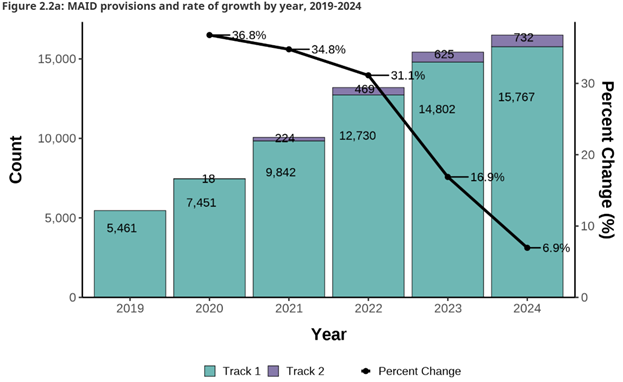
In 2024, 16,499 Canadians had their lives ended by a doctor or nurse. This marks a 6.9% increase over euthanasia deaths in 2023. A 6.9% increase is smaller than the 15.8% increase between 2022-2023, but it still represents more than 1100 additional euthanasia deaths than last year. Euthanasia as a percentage of all deaths in Canada has increased from 4.7% in 2023 to 5.1% in 2024, accounting for more than 1 in every 20 deaths in Canada.
With the exception of New Brunswick, Manitoba, and Saskatchewan, the number of euthanasia deaths increased in every province. The majority of euthanasia deaths happen in Quebec (36.4%), Ontario (30.0%), and British Columbia (18.2%). Quebec (67 MAiD deaths/100,000 people), British Columbia (53 MAiD deaths/100,000 people), and Nova Scotia (41 MAiD deaths/100,000 people) have the highest rates of euthanasia, while Newfoundland & Labrador (20 MAiD deaths/100,000 people) and Manitoba (12 MAiD deaths/100,000 people) have the lowest.
The number of euthanasia deaths could have been higher. While 16,499 Canadians died by MAiD, there were 22,535 total requests for euthanasia. 1,327 were deemed ineligible. Another 692 withdrew their request for euthanasia, and 4,017 died prior to receiving euthanasia.
Of euthanasia deaths in 2024, 95.6% (15,767) were on Track 1, where death is ‘reasonably foreseeable’ and there are fewer safeguards. The remaining 4.4% (732) were euthanized on track 2, where death is not ‘reasonably foreseeable’ and there are additional safeguards in place. The 732 euthanized Canadians who were not nearing natural death are an increase from 625 in 2023, a jump of over 17%. The sad reality is that there are many people being euthanized who may have years to live because some doctors interpret ‘reasonably foreseeable’ natural death very flexibly.
Medical Assistance in Dying technically includes both euthanasia (where a doctor or nurse ends a patient’s life) and assisted suicide (where a patient takes their own life with the help of a doctor or nurse). However, in 2024, doctors and nurses administered all MAID deaths.
Although over 16,000 Canadians died by euthanasia in 2024, only 2,266 doctors and nurses administered euthanasia, an increase of 66 from 2023. Just 102 doctors and nurses were responsible for 6,185 euthanasia deaths. That’s an average of 60 deaths each. For these 102 doctors and nurses, actively ending a patient’s life is a weekly process.
Illness and Suffering
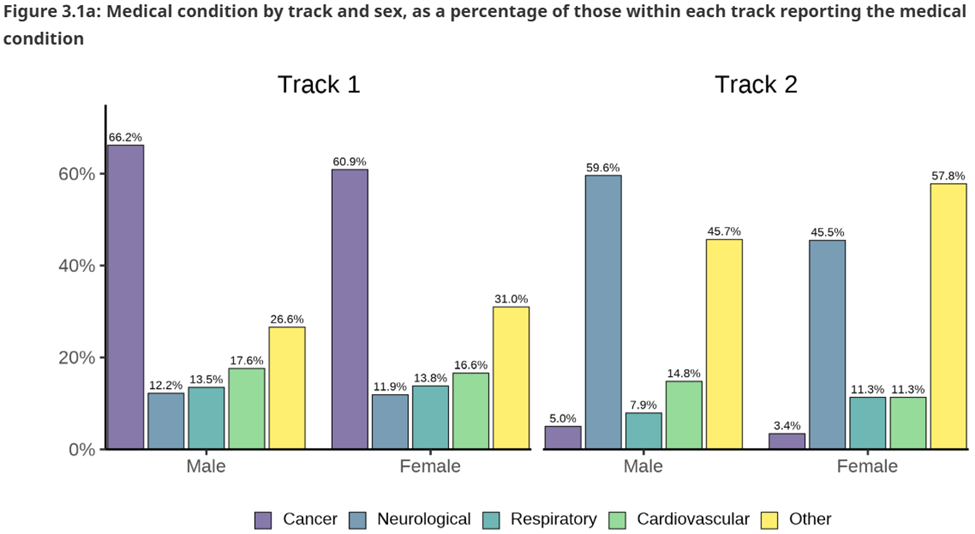
The underlying medical condition of those euthanized is categorized as either cancer, neurological, respiratory, cardiovascular, or other conditions. The “other” category includes diabetes, frailty, autoimmune conditions, chronic pain and mental disorders. For track 1, cancer is the most frequent medical condition, followed by “other” conditions. For track 2 patients, neurological conditions and “other” conditions were the top conditions for men and women respectively. While the report does not give numbers for each of these categories, past reports have revealed increasing numbers of patients being euthanized for frailty. This raises questions about how doctors might be assessing eligibility. If something like frailty can make a person eligible for euthanasia, doctors can be quite loose in their interpretations.
Health Canada also notes the causes of suffering indicated by patients choosing euthanasia. Patients can select multiple options that reflect their suffering. The most commonly cited source of suffering is the loss of ability to engage in meaningful activities (over 95%), followed by loss of ability to perform activities of daily living (over 85%). Loss of dignity is listed fourth at over 63% for those nearing natural death and over 73% for those not nearing natural death. Fewer than 60% cite inadequate pain control, or concern about it.
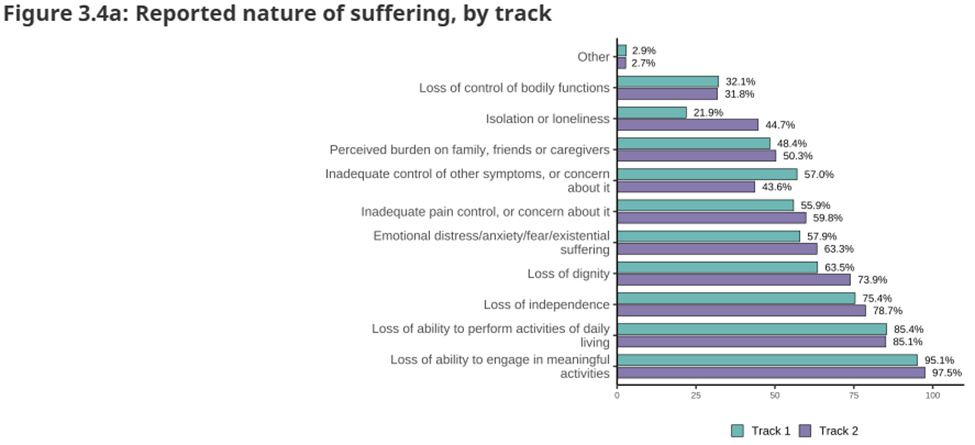
Isolation and loneliness continue to be a common source of suffering, cited by 21.9% of those nearing natural death and 44.7% of those not nearing natural death. Health Canada attempts to mitigate concerns about this statistic by saying that those who cite isolation and loneliness typically cite over 7 sources of suffering. The report also notes that isolation or loneliness was never cited as the only source of suffering. But isolation and loneliness are still non-medical factors that contribute to a request for death and compound other sources of suffering.
The number of patients who feel like a burden on family, friends, or caregivers has also increased, cited by 48.4% of those nearing natural death, and 50.3% of those not nearing natural death. Again, Health Canada attempts to mitigate concerns about this by saying that this is a common feeling for people with serious illness and that people who cited this type of suffering typically chose nearly 7 sources of suffering. They note that being a self-perceived burden was cited as the only source of suffering in less than five cases, and alongside only one other type of suffering in 18 cases. Canadians are requesting death for so many different reasons, many of which are social factors that require care from health care systems and local communities. Loneliness, a loss of meaning or a loss of ability, and a faulty view of human dignity are increasingly seen as suffering that no one should have to live with, and for which euthanasia may be the answer. But despite very real suffering in many cases, death should never be the answer.
The report also shows the need for better care within the medical system. Nearly 3% of people required palliative care but did not receive it. While fewer people are listed as requiring disability support services and not receiving them, the report states that it was unknown whether disability support services were required in 17% of all euthanasia deaths. While there may be many reasons for this, one possible explanation is that Canada’s law only requires patients to consider options that may alleviate their suffering, not necessarily to try such options.
Conclusion
Health Canada’s latest report shows the continued growth and normalization of euthanasia in Canada. As we explained in another recent article, even the supposed safeguards in place around euthanasia often fail to protect vulnerable Canadians. In addition, there is very little real oversight to ensure that those who are dying meet the eligibility criteria and that doctors are following the law. For example, between 2018 and 2023, there were over 400 cases of possible noncompliance with the law and virtually no repercussions.
We must never see euthanasia as a solution for suffering. Instead, we must continue to care for, not kill, those who wish to die. In the meantime, the federal government continues to move ahead with the expansion of euthanasia to those with mental illness as their only condition. Unless repealed, that expansion will take place on March 17, 2027. Check out Care Not Kill for action items to raise awareness and to call on elected officials to commit to protecting Canadians from euthanasia.