The Problem with British Columbia’s Human Rights Regime


Available in Audio Format:
Last week, the BC Human Rights Tribunal fined former school trustee Barry Neufeld $750,000 for hateful and discriminatory speech under BC’s Human Rights Code. Neufeld’s comments decried gender ideology in schools. In response to this decision, some politicians are calling for the abolition of human rights tribunals.
But how do these tribunals work? And what’s the problem with them? Let’s consider these questions in light of Neufeld’s case.
Human Rights Code, Tribunal, and Commission in British Columbia
The BC Human Rights Code is supposed to ensure that all individuals residing in British Columbia are treated fairly when seeking employment, housing, services, or goods. The Code therefore prohibits discrimination based on the “Indigenous identity, race, colour, ancestry, place of origin, political belief, religion, marital status, family status, physical or mental disability, sex, sexual orientation, gender identity or expression.” The Code establishes both the Human Rights Commissions and Human Rights Tribunal and authorizes the latter to award remedies to victims of unlawful discrimination.
The BC Human Rights Tribunals function much like a court. If a person feels like they have been discriminated against, they can bring a human rights complaint to the Tribunal. If the Tribunal determines that a discriminatory practice has indeed taken place, the Tribunal may order the reversal of the practice or make recommendations to ensure its end. The Tribunal may also order compensation to be paid to the complainant. Unlike the courts, the Tribunals are not required to follow procedural checks and balances to ensure a fair trial.
If the BC Human Rights Tribunal adjudicates individual discrimination complaints, the BC Human Rights Commission investigates broader trends, laws, and policies. Their mandate is “to address the root causes of inequality, discrimination and injustice in B.C. by shifting laws, policies, practices and cultures. We do this work through education, research, advocacy, inquiry and monitoring.”
The Stand Up for Freedom Campaign
Although human rights codes, commissions, and tribunals sound nice in theory, they are problematic in practice.
One of ARPA’s first campaigns, the Stand Up for Freedom campaign, highlighted over two dozen problems with human rights codes, commissions, and tribunals and called for them to be reformed, replaced, or removed. Although they have changed quite a bit since then, here are the biggest problems that remain today:
- The Tribunal’s quasi-judicial rules short-circuit many of the vital checks and balances that exist in our court systems.
- The tendency for the Tribunal to impose large fines on the respondents bears little resemblance to the intended remedial nature of the system.
- The inability of the respondent to be awarded costs removes the common law impediment to frivolous complaints.
- Some remedial orders have involved forced statements, false confessions, coerced recantations, and “diversity training” which contravene the fundamental right to freedom of conscience, opinion and expression.
- The abundance of lucrative awards and the ability to punish a political or ideological opponent encourage activists to weaponize the system.
- The Tribunal may find a respondent in contravention of the Code without any proof of intent or any evidence of harm.
- Human rights codes – especially those with provisions on hate speech or discriminatory speech – contravene fundamental Charter freedoms.
These problems are clearly on display in the recent human rights tribunal decision against Barry Neufeld.
The Case of Barry Neufeld
Barry Neufeld was a school trustee in Chilliwack, British Columbia. He was elected for three terms in 2011, 2014, and 2018, earning the second-most votes of the seven school trustees in each of those elections.
In 2016, British Columbia amended its Human Rights Code to recognize and protect people based on their sexual orientation and gender identity (SOGI). In 2017, the province introduced SOGI 123 in schools to prevent bullying based on sexual orientation or gender identity, teach students progressive sexual and gender ideology, and create more LGBTQ-friendly facilities.
But Neufeld is a Christian and refused to promote this unchristian ideology. At school board meetings, in social media posts, and through speeches, Neufeld called out SOGI as a lie that contradicts the reality of who people are and how they ought to identify.
After the British Columbia Teachers’ Federation and their president publicly disparaged Neufeld for his anti-SOGI comments, even accusing him of hate speech, Neufeld filed a defamation case to defend his name. Neufeld’s lawsuit was ultimately tossed out by the Supreme Court of Canada, in part because it would limit his opponents’ freedom to speak out on an issue of public importance.
Meanwhile, the British Columbia Teachers’ Federation and the Chilliwack Teachers’ Association filed a human rights complaint against Neufeld. They alleged that he discriminated against members of the LGBTQ community and that many of his comments amounted to hate speech under British Columbia’s Human Rights Code.
Last week, the British Columbia Human Rights Tribunal issued its decision. They found that Neufeld had published discriminatory and hate-promoting statements and ordered him to pay $750,000. These funds would be distributed to any Chilliwack school teacher who identified as LGBTQ to compensate for “injury to their dignity, feelings, and self-respect.”
As it stands right now, this ruling sets a precedent that anyone who publicly criticizes gender ideology could receive the same treatment as Neufeld: a complaint, a hearing, and a penalty from the British Columbia Human Rights Tribunal.
While Neufeld’s position as a trustee was a relevant factor for the finding that his comments were discriminatory, this was far less relevant to the decision that his comments were hateful. Nothing in the Tribunal decision rules out the possibility that public statements by regular citizens could be hateful. Consequently, Christians could be severely fined for expressing their views on gender and sexuality in public. Now, Neufeld will almost assuredly appeal this decision, and so it might be overturned by a court. But unless this happens, this decision is a real cudgel that can be used against Christian expression.
Conservative Politicians Express Concern
Many conservative politicians have commented on the Tribunal ruling. Federal Conservative leader Pierre Poilievre expressed his concern on X.
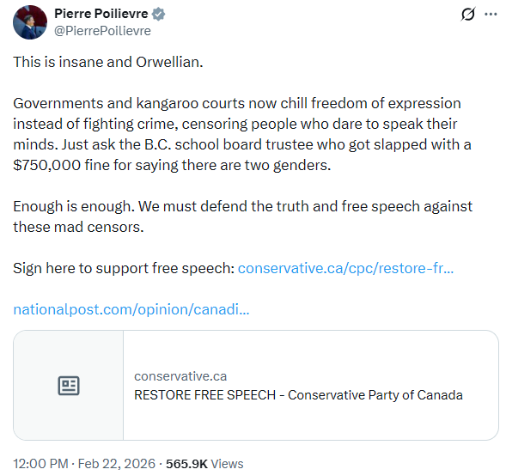
Provincial Conservative MLAs and leadership candidates lambasted the decision. Harman Bhangu, an MLA and Conservative leadership candidate, called the tribunal a “kangaroo court run by a woke activist judiciary.” Another leadership candidate, Caroline Elliott, warned that this case “kills free speech and erodes democracy.”
But it was an independent MLA who took immediate action. On Thursday, Tara Armstrong introduced the Human Rights Code Repeal Act. Sadly, the legislation was voted down at first reading by the NDP, Greens, and two independents, though the Conservatives and remaining independents voted in favour. Historically, this would be an exceptionally rare outcome, but it has become increasingly common in recent years in British Columbia. First reading is usually a procedural vote to allow a bill to be added to the legislature’s agenda. Substantial debate on the merits of the bill happens at second reading. Voting in favour at first reading isn’t usually counted as a signal of whether an MLA is for or against the legislation.
ARPA’s Stand Up for Freedom campaign outlined various options to reform, replace, or remove the human rights apparatus. Each option has its advantages and its disadvantages. Armstrong’s bill proposed the most far-reaching option: abolish not just the tribunal and the commission but the Code as well.
A narrower but still significant option would be to repeal section 7 of BC’s Human Rights Code, which prohibits “hate speech” and discriminatory speech. Most provinces do not have such a provision, but those that do (British Columbia, Alberta, Saskatchewan) should repeal it.
So, what can we do?
Let’s take this opportunity to let our provincial MLAs know that British Columbia’s Human Rights Code, Commission, and Tribunal need to be reformed or eliminated. Otherwise, Neufeld’s fine of $750,000 for publicly expressing traditional views of gender and sexuality could be something that we might soon face.