
Canada’s federal law on “medical assistance in dying” (or “MAID”) does far too little to protect vulnerable people.
People are requesting and dying by MAID due to unaddressed mental illness, addiction, housing insecurity, and social vulnerability.
_____
Provinces provide health care services.
Provinces license and regulate health care professionals.
_____
Provinces must ensure patients get the care they need, rather than offer them death by MAID.

Thomas Dillon
Thomas Dillon suffered from inflammatory bowel disease. Thomas had a history of alcohol addiction, mental illness, and suicidality. During one psychiatry assessment, his psychiatrist asked him if he was aware of euthanasia. His family doctor exchanged text messages with him about his family’s opposition to MAID and told him that it wasn’t about them. It was about his choice. Thomas’s doctor met him at a Tim Hortons, where the doctor assessed Thomas for MAID. Six months later, the doctor met Thomas at the Tim Hortons again and drove Thomas to a funeral facility where he ended Thomas’ life.
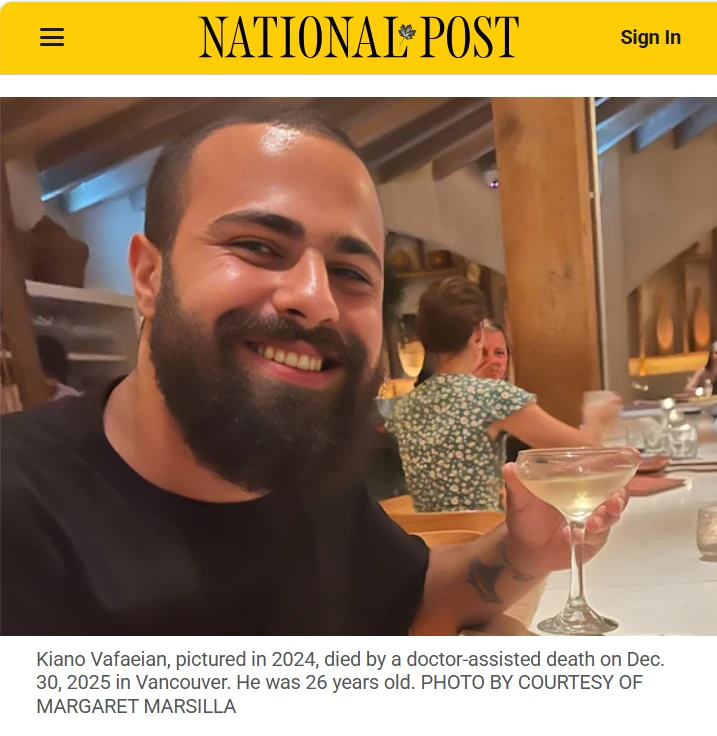
Kiano Vafaeian
Kiano Vafaeian had diabetes, and he had lost vision in one eye. He also suffered from mental illness. Despite having no major medical condition and his own doctors describing him as “young and healthy,” Vafaeian died by MAID on December 30, 2025, at the age of 26.
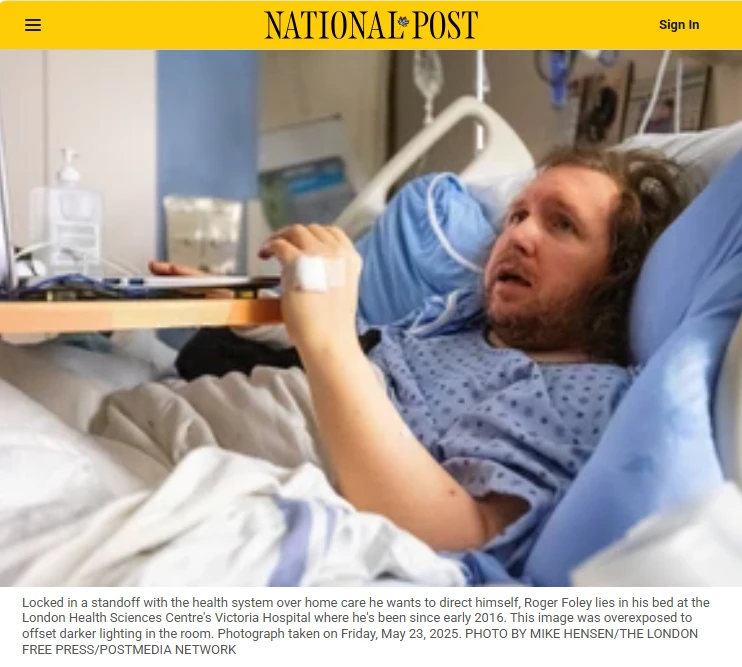
ROGER fOLEY
Ontario man, Roger Foley, suffers from spinocerebellar ataxia, a neurodegenerative condition. Despite his desire to live with the necessary care, his health care providers often remind him that MAID is an option. Foley remains in the hospital because he cannot get adequate home care.
Thomas, Kiano, and Roger are three people MAID safeguards would help protect.
There are many more.

(2024)

(2024)
What Can I Do?
Take action and write a letter to your Member of Provincial Parliament (MPP).
Let your elected representative know why protecting vulnerable Canadians matters.
Send an easy mailFrequently asked questions
Isn’t regulating MAID the federal government’s responsibility?
Federal law sets out basic eligibility criteria for euthanasia under the Criminal Code. But these criteria are inadequate to screen out vulnerable patients who feel pressured to consider MAID, or to seek MAID due to economic or psychosocial factors. The courts have been clear that both federal and provincial governments have authority to enact MAID safeguards. Provinces cannot criminalize MAID, but they can set in place additional safeguards to protect vulnerable patients. Alberta and Quebec have both passed their own provincial MAID legislation.
Isn’t MAID only used to end unbearable suffering?
Patients are being euthanized whose suffering could be relieved in other ways, over time. Provincial safeguards should seek to protect vulnerable patients from dying by MAID when there are other options available. For example, some patients in crisis have been offered MAID instead of help to live well. Others have requested MAID despite unaddressed mental illness, economic vulnerability, housing insecurity, or lack of social support.
Isn’t it only religious people who want to restrict MAID?
Our organization’s concern for the vulnerable is rooted in our Christian faith, but religious and non-religious Canadians across the political spectrum have raised serious concerns about MAID in Canada. Last year, the United Nations Committee on the Rights of Persons with Disabilities said it was “extremely concerned” and recommended repealing MAID for people who are not nearing natural death. Disability rights advocates across the country have condemned offering MAID to Canadians with disabilities who are not dying.
What are the big problems with MAID in Canada?
MAID is the 4th leading cause of death in Canada, and we have the fastest growing rate of MAID in the world. Over 100,000 Canadians have died by MAID in just 10 years. In 2024, 16,499 Canadians died by MAID. California, by contrast, had only 1,032 assisted suicide deaths the same year, despite having a population roughly equivalent to Canada’s. Reports from the Ontario Coroner’s office have revealed that MAID is often offered as a solution for suffering rather than a last resort, that medical professionals sometimes fail to follow existing safeguards, and that patients with unresolved mental illness, addiction, and other concerns receive MAID instead of the help they need. Nearly 50% of those who die by MAID feel like a burden on loved ones, and nearly 45% of those who received MAID but were not dying suffered from isolation and loneliness.
What kind of provincial safeguards are you advocating for?
Doctors and nurses should never start a conversation about MAID with a patient. Instead, they should only discuss MAID when asked about it.
MAID should never be offered for mental illness or disability. Rather, provinces should only permit MAID where a patient’s prognosis of natural death is six months or less.
There should also be better procedures to detect external pressures that may be affecting someone’s decision to choose MAID. For example, including family members and ensuring a patient’s previous doctors have been consulted.
Finally, provinces should respect the freedom of health care professionals and institutions not to provide or facilitate MAID.
Resources
“Sixth Annual Report on Medical Assistance in Dying in Canada,” Government of Canada, (November 2025).
Committee on the Rights of Persons with Disabilities, “Concluding observations on the combined second and third periodic reports of Canada,” United Nations, April 15, 2025
Ramona Coelho, K. Sonu Gain, and Trudo Lemmens, eds., Unravelling MAiD in Canada, (McGill-Queen’s University Press, 2025).
Mary J. Shariff, Derek BM Ross, and Trudo Lemmens, “Mental Illness, Health Care, and Assisted Death: Examining Parameters for Expanding or Restricting MAID under Canada’s Charter and Federal System,” Manitoba Law Journal 47, (2024).
Ramona Coelho et al., “The realities of Medical Assistance in Dying in Canada,” Palliative & Supportive Care 21 (no. 5), (2023).
Daniel Zekveld, “Ring the alarm – Canada is failing to safeguard those with mental illness from MAID,” The Hub, April 25, 2024.
Daniel Zekveld, “Better MAiD oversight is needed to protect patients,” Policy Options, Dec. 6, 2024.